
|
|
Soumendra Nath Thakur
ORCiD:0000-0003-1871-7803
Tagore’s Electronic Lab, India
postmasterenator@gmail.com | postmasterenator@telitnetwork.in
February 21, 2026
Published: Planck Epoch Through the Phase-Indexed Velocity Stabilization Lens of Extended Classical Mechanics (ECM)
DOI: https://doi.org/10.5281/zenodo.18725040
ECM Portal: http://www.telitnetwork.itgo.com/Planck-Epoch-Lens-of-ECM.html
The Planck epoch is conventionally described as the earliest measurable interval of cosmic history, extending from t₀ = 0 to approximately 10⁻³⁴ seconds (Epoch scale), characterized by extreme temperature, density, and unified interactions. In Extended Classical Mechanics (ECM), this epoch is reinterpreted not as a singular explosive origin but as a primordial frequency–mass phase transformation governed by phase-indexed evolution. The framework introduces Phase-Indexed Velocity Stabilization (PIVS), where velocity emerges from an initially superluminal manifestation regime and asymptotically stabilizes at v = c at a terminal phase index of 360°. This stabilization marks the structural birth of metric spacetime, gravitational differentiation, and classical causal order.
The Planck regime is thus modeled as a NAM-dominant (Negative Apparent Mass) gradient state, where Mᵃᵖᵖ ≡ −ΔPEᴇᴄᴍ drives redistribution into ΔMᴍ and ΔKEᴇᴄᴍ. The early universe is described as a gradient relaxation process rather than geometric explosion. This interpretation unifies the emergence of time, velocity invariance, matter manifestation, and gravitational structure within a single phase-regulated transformation framework.
Keywords: Planck Epoch, Extended Classical Mechanics, Phase-Indexed Velocity Stabilization, Negative Apparent Mass (NAM), Mᵃᵖᵖ, ΔPEᴇᴄᴍ, Emergent Spacetime, Frequency-Mass Transformation, Light-Speed Stabilization
The Planck epoch, extending from t₀ = 0 (Pre-manifest state) to approximately 10⁻³⁴ seconds, represents the earliest definable regime of cosmic evolution. Conventional cosmology describes this period as one of extreme temperature (~10³² K) and unified interactions.
Within ECM, however, this epoch is interpreted as a primordial wavelength-compressed manifestation state, where frequency normalization remains near the Planck reference scale. Spacetime does not pre-exist at t₀ = 0. Instead, it emerges through phase-regulated stabilization.
The Planck regime corresponds to the earliest stage of frequency–mass transformation, governed by structural relations embedded in Planck-scale constants and their phase-indexed evolution.
In ECM, the earliest cosmic condition is characterized by:
Velocity, energy, and matter are phase-coupled expressions of a single conserved manifestation content.
The superluminal magnitude arises from sub-Planck wavelength compression (λ₀ ≪ ℓₚ), not from frequency divergence beyond the Planck scale. This does not imply faster-than-light propagation in established spacetime. Rather, spacetime itself is not yet stabilized. Velocity is phase-driven, not geometry-constrained.
As phase evolves, −ΔPEᴇᴄᴍ redistributes into ΔMᴍ and ΔKEᴇᴄᴍ, reducing frequency compression and stabilizing velocity.
The light-speed constant emerges as a phase-stabilized equilibrium outcome. This marks the onset of structured spacetime and classical causal order.
At early phase indices, Mᵃᵖᵖ is maximal, corresponding to extreme gradient dominance and superluminal manifestation. As phase evolves:
Thus, the Planck epoch represents a NAM-driven redistribution cascade. Velocity stabilization corresponds to reduction of gradient excess and emergence of structured gravitational behavior.
Cosmic time emerges through entropic redistribution. The Planck phase corresponds to maximal temporal distortion, with regularized clock-time equivalence emerging only after velocity stabilization.
Within ECM, the Planck epoch is:
Not an explosion,
but a stabilization.
Not a singular breakdown,
but the emergence of law-governed structure.
Within Extended Classical Mechanics (ECM), Negative Apparent Mass (NAM) is not an independent substance but the measurable gradient expression of latent potential redistribution. It represents the manifestation driver linking potential, matter, and kinetic domains.
NAM (Mᵃᵖᵖ) functions as the gradient catalyst through which latent phase content redistributes into matter (ΔMᴍ) and dynamical energy (ΔKEᴇᴄᴍ). All three remain projections of a conserved phase structure.
At the earliest phase indices approaching 0°:
This regime is NAM-dominant rather than matter-dominant. Extreme Mᵃᵖᵖ corresponds to maximal frequency density and unstable superluminal manifestation (v ≫ c), prior to spacetime stabilization.
As phase evolves:
NAM progressively redistributes into matter manifestation and kinetic structure. This redistribution constitutes the physical meaning of early cosmic evolution in ECM - not metric expansion, but gradient relaxation.
Velocity in the PIVS framework depends on the magnitude of Mapp. Large NAM gradients sustain superluminal manifestation, while decreasing gradients drive stabilization.
Light-speed invariance emerges as the minimum sustainable NAM gradient compatible with structured spacetime. Velocity stabilization therefore represents gradient equilibrium.
Gravitation in ECM is interpreted as the spatial structuring of Mapp gradients. During the Planck regime, gradients are extreme but not yet geometrically organized. Gravitational behavior becomes definable only after phase stabilization.
NAM decay corresponds to entropic increase. The Planck epoch therefore represents minimal entropy and maximal gradient compression. Temporal regularization emerges as gradients smooth and velocity stabilizes.
The Planck epoch is thus a NAM-driven stabilization process -
a regulated redistribution of latent potential into law-governed structure.
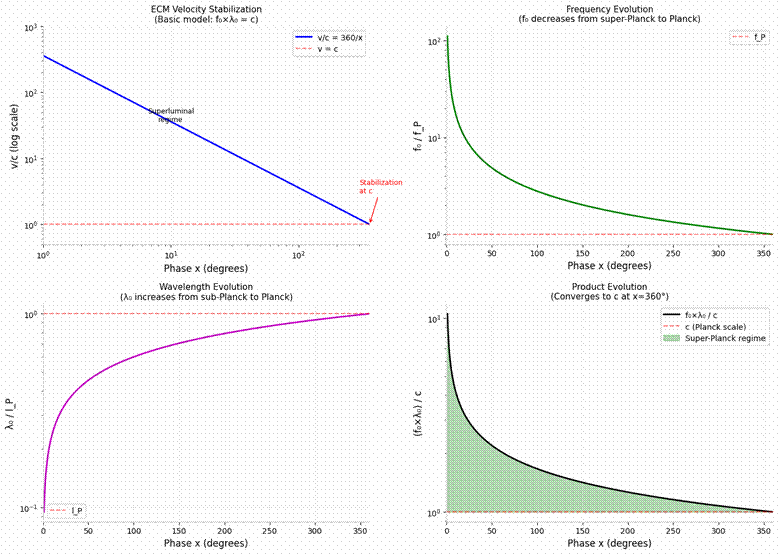
Figure 1. Phase-Indexed Velocity Stabilization (PIVS) model in Extended Classical Mechanics. The four panels illustrate: (i) velocity ratio evolution (v/c), (ii) frequency normalization (f0/fP), (iii) wavelength normalization (λ0/ℓP), and (iv) product convergence (f0λ0/c).
Convergence at θ = 360° establishes the locking condition f0λ0 = c, marking stabilization rather than singular divergence.
Figure 1: ECM Velocity Stabilization Model — f0 × λ0 → c at θ = 360°
Figure 1 presents a four-panel analytical visualization of the Planck epoch under the Phase-Indexed Velocity Stabilization (PIVS) framework of Extended Classical Mechanics (ECM). The horizontal axis in all panels represents the phase index θ (degrees), ranging from near 0° to 360°.
The panels depict:
The graphical structure encodes the Planck epoch as a continuous phase-regulated stabilization process rather than a singular divergence.
As θ → 0°, the ratio v/c becomes large, representing an early phase manifestation regime prior to light-speed stabilization.
As θ → 360°, velocity converges to:
This marks the stabilization boundary of PIVS. The dynamical excess in early phase indices concerns phase-indexed velocity behavior — not superluminal motion within an established metric geometry.
Velocity excess in this regime is governed primarily by sub-Planck wavelength compression, not by physically divergent frequency magnitude.
The frequency panel displays:
As phase evolves, the ratio monotonically decreases toward unity at θ = 360°. This represents stabilization relative to the Planck reference scale.
Clarification for the labeling under “Frequency Evolution":
The term “super-Planck” in the frequency panel refers to early phase-index
normalization within the first 1 Hz band of f0, not to a physically
divergent frequency magnitude. Velocity excess in this regime is governed by
sub-Planck wavelength compression rather than frequency amplification.
Importantly, the plotted curve implies
but does not require
The earlier interpretational concern arose from terminology, not from structural inconsistency in the plotted curves.
Initial sub-Planck compression transitions smoothly toward Planck-scale normalization at θ = 360°.
Wavelength expansion provides the dominant stabilizing mechanism. The convergence process is therefore governed primarily by wavelength redistribution rather than frequency divergence.
The product panel shows monotonic convergence toward unity. At stabilization:
This defines the locking condition of the Planck epoch and marks the structural emergence of light-speed invariance.
The earlier objection treated the frequency panel as structurally implying frequency dominance. This has now been clarified.
The mischaracterization originated from the wording of the frequency panel description rather than from the mathematical behavior of the curves. With corrected terminology, the figure and the analytical interpretation are fully aligned.
The Planck Epoch is therefore a stabilization phase —
not a singular explosion,
but a frequency–mass phase transition governed by phase-indexed convergence.
The Planck epoch, when interpreted through the Phase-Indexed Velocity Stabilization (PIVS) framework of Extended Classical Mechanics (ECM), is no longer understood as a singular explosive beginning. Instead, it represents a regulated phase transition governed by frequency–mass redistribution and gradient stabilization.
At early phase indices (θ → 0°), the system is NAM-dominant, with maximal Mᵃᵖᵖ ≡ −ΔPEᴇᴄᴍ, sub-Planck wavelength compression (λ₀ ≪ ℓᴘ), and superluminal manifestation (v ≫ c) in a pre-geometric regime. Frequency remains near the Planck reference scale (f₀ > fᴘ, not f₀ ≫ fᴘ). Spacetime, as a structured metric entity, is not yet stabilized.
Through continuous phase evolution (0° → 360°), Negative Apparent Mass redistributes into matter (ΔMᴍ) and kinetic structure (ΔKEᴇᴄᴍ). Velocity progressively converges, and the fundamental locking condition
is achieved at θ = 360°, marking the stabilization of light-speed invariance and the operational birth of structured spacetime.
Gravitation emerges not as curvature imposed upon pre-existing geometry, but as structured gradients of Mᵃᵖᵖ:
Cosmic time regularizes as entropic redistribution progresses, and the early maximal gradient regime transitions into law-governed dynamical order.
Thus, the Planck epoch within ECM is best described as:
The beginning of the universe was not an explosion,
but a stabilization.
Not a breakdown of physics,
but the emergence of physical law.