
|
|
This paper introduces Extended Classical Mechanics (ECM), a deterministic emergence cosmology framework formulated on phase-frequency kernel ontology. The study proposes that universal structure, including matter, energy, spacetime projection, and gravitational response, may emerge from an underlying oscillatory existential field rather than from curvature-dominated geometric foundations. The ECM framework models primordial existence as a pre-geometric kernel vibration manifold characterized by phase-amplitude functional dynamics. Cosmogenesis is interpreted as a continuous deterministic transition from latent potential domain to manifested structural reality through gradient relaxation of kernel excitation fields. Core theoretical constructs include energy–frequency manifestation duality, mediating mass structure, finite universe manifold hypothesis, and attractor equilibrium closure of phase-energy functional systems. Gravitational interaction is reformulated as projection-response geometry arising from residual phase potential gradients. The model emphasizes sub-Planck scale emergence physics, where spatial and temporal metrics are treated as projection phenomena rather than fundamental ontological primitives. In this regime, superluminal initial transformation behaviour is interpreted as domain-internal phase redistribution rather than conventional spacetime signal propagation. The objective of ECM is to provide a conceptual deterministic framework for exploring universal origin structure, cosmic evolution ordering, and kernel-based grand unification synthesis within an existence-first theoretical paradigm.
Extended Classical Mechanics; deterministic emergence; phase-frequency ontology; kernel cosmology; pre-geometric physics; finite universe hypothesis; gravitational projection response.
The investigation of fundamental cosmological structure and the nature of physical reality remains a central problem in theoretical physics and philosophy of science. Conventional scientific frameworks primarily describe universal evolution through geometric spacetime dynamics, quantum interaction models, and thermodynamic statistical interpretation. Despite significant progress, questions regarding primordial origin structure, deterministic emergence ordering, and foundational ontological substrate remain open. This work presents Extended Classical Mechanics (ECM), a deterministic emergence cosmology framework based on phase-frequency kernel ontology. ECM proposes that reality may be interpreted as a self-organizing vibrational manifold in which existential states evolve through gradient relaxation of kernel phase-energy functional fields.
Unlike curvature-dominant spacetime formulations, ECM adopts an existence-first conceptual paradigm. In this model, matter, energy, and spacetime geometry are treated as emergent projection responses arising from deeper oscillatory kernel dynamics rather than fundamental irreducible entities.
The primary hypothesis of this study is that cosmogenesis and universal structural evolution can be represented as deterministic redistribution of existential kernel excitation across hierarchical manifestation domains. Energy transformation, mass mediation, and gravitational response are interpreted as structural constraints resulting from phase-field stabilization processes.
Special consideration is given to sub-Planck scale regimes where primordial existence is modeled as a pre-geometric oscillatory kernel state. In this domain, spatial metric properties are treated as emergent projections rather than intrinsic ontological foundations. The framework further explores finite manifold cosmology, asymptotic attractor closure behaviour, and spectral entropy–like ordering of existential emergence.
The objective of ECM research is not to replace established physical theories but to provide an alternative conceptual physics framework exploring deterministic emergence structure of the universe. Experimental or observational correspondence, when applicable, must be derived through ECM-specific functional mapping rather than direct reinterpretation of conventional relativistic mechanics.
The Extended Classical Mechanics (ECM) framework employs a theory-specific symbolic system. All quantities are defined within ECM ontology and may not be interpreted using conventional relativistic mechanics unless explicitly stated.
| ECM Term | Symbol | Definition |
|---|---|---|
| aᵉᶠᶠ | AEFF | Effective emergence acceleration |
| Fᴇᴄᴍ | FECM | ECM equivalent force functional |
| gᵉᶠᶠ | GEFF | Effective gravitational response field |
| KEᴇᴄᴍ | KEECM | Emergent kinetic energy domain |
| PEᴇᴄᴍ | PEECM | Kernel potential energy manifold |
| Mᵃᵖᵖ | MAPP | Apparent mass projection response |
| Mᵉᶠᶠ | MEFF | Effective manifestation mass |
| Mᴍ | MM | Mediating existence mass kernel |
| Δt | DT | Cosmic phase ordering interval |
Registry quantities are defined as ECM internal ontology variables and are not assumed to represent standard physical measurement units unless explicitly mapped.
ΔKEᴇᴄᴍ − ΔPEᴇᴄᴍ → +ΔPEᴇᴄᴍ
Mᵃᵖᵖ ≡ −ΔPEᴇᴄᴍ
ΔMᴍ ↔ Δm
Energy and mass transformations occur through phase-frequency kernel redistribution rather than classical inertial mechanics.
The correspondence ΔMᴍ ↔ Δm is valid only under local-scale approximation where dynamic mass modulation |Mᴅᴍ| is negligible compared to structural origin mass Mᴏʀᴅ. For cosmological-scale applications: Mᴍ = Mᴏʀᴅ + Mᴅᴍ must be enforced.
All ECM relations are defined within the phase-frequency emergence ontology and are not assumed to represent relativistic spacetime mechanics unless explicitly stated.
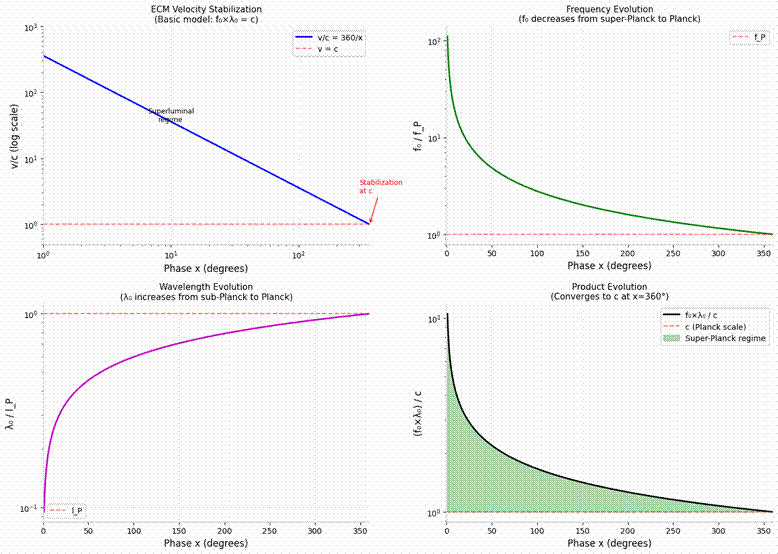
Figure 1. The graph illustrates phase-frequency governed velocity evolution during early manifestation dynamics. The stabilization curve represents gradient relaxation of kernel excitation as the system transitions from high-energy primordial oscillatory regime toward structured manifestation equilibrium.
The horizontal axis denotes phase-indexed emergence progression, while the vertical axis represents effective propagation response. The asymptotic convergence behavior reflects attractor stabilization consistent with deterministic kernel manifold dynamics.
This work establishes a deterministic emergence-based cosmological framework designated as Extended Classical Mechanics (ECM). The ontology is structured upon an existence-first, phase-frequency kernel foundation rather than curvature-primacy formulations.
The Extended Classical Mechanics (ECM) framework is developed as a theoretical physics ontology model based on deterministic phase-frequency emergence dynamics. The methodology does not rely on experimental measurement protocols but instead establishes internal structural consistency conditions for kernel-state evolution.
Existential states are modeled as oscillatory kernel manifolds characterized by phase parameterization and spectral energy redistribution.
E_kernel = k f
where k represents ontology-specific emergence coupling coefficient and f represents kernel frequency state.
The framework assumes bidirectional manifestation symmetry between energy and mediating mass sectors.
kf ↔ hf ↔ M_M c² ↔ PE_ECM ↔ KE_ECM
Dynamic state evolution follows gradient relaxation of phase-energy functional fields.
In the ultra-early emergence regime, the model considers a pre-geometric phase domain where characteristic wavelength satisfies
λ₀ ≪ ℓᴘ
Within this regime, propagation is interpreted in a non-spatial existential manifold where effective phase velocity may exceed conventional light-speed constraint without violating causal ontology, since spatial metric projection is not yet defined.
The energy scaling relation in the pre-spatial kernel domain is expressed as
k = h ( fᴘ / f₀ )
ΔE₀ = k f₀ = ΔKEᴇᴄᴍ
This represents primordial kinetic emergence excitation rather than relativistic kinetic energy.
The Extended Classical Mechanics (ECM) framework is defined within a phase-frequency emergence ontology. All mathematical and physical relations presented herein are internal-consistency constructs of the ECM model and are not intended to be interpreted as conventional relativistic spacetime mechanics unless explicitly stated.
The theoretical structure assumes deterministic kernel state evolution governed by existential phase redistribution dynamics. Observational correspondence, when applicable, must be derived through ECM-specific functional mapping.
The ontological formulation of ECM assumes that primordial existence is represented as a phase-amplitude kernel state. The model does not assert physical vacuum ontology in classical relativistic sense but defines existence as intrinsic phase-frequency manifestation potential.
Φ_origin = Φ₀ + δΦ_unobservable
Primordial existence is governed by kernel oscillatory dynamics. The source state represents maximal symmetry with minimal informational differentiation.
Φ_origin represents primordial phase existence amplitude. Φ₀ denotes maximal symmetry kernel baseline. δΦ_unobservable represents sub-manifestation fluctuation field which may not be directly observable under macroscopic projection regimes.
kf → hf
The relation E = kf represents unmanifested kernel frequency energy potential. The relation E = hf represents manifested quantum excitation domain. The transformation kf → hf is interpreted as emergence quantization of primordial oscillatory structure rather than classical thermodynamic conversion.
Energy-frequency manifestation is defined within ECM phase ontology and should not be directly equated with standard classical or relativistic energy transformation laws.
θ ∈ [0°, 360°]
The phase domain θ ∈ [0°, 360°] represents complete existential emergence cycle parameterization. Early phase region corresponds to high latent potential state. Late phase region corresponds to stabilized manifestation structure. Cosmogenesis is interpreted as deterministic phase relaxation trajectory within kernel frequency manifold.
Cosmogenesis is modeled as complete phase-cycle evolution transitioning from latent potential to manifested structure.
g_ECM ∝ ∇M_app
Gravity within ECM ontology is interpreted as projection response of phase-frequency kernel gradient field. M_app ≡ −ΔPE_ECM represents manifestation constraint mass.
lim (r → r_max_universe) M_eff(r) → 0
The finite universe manifold hypothesis proposes that kernel manifestation potential asymptotically approaches equilibrium as radial coordinate r approaches the boundary scale r_max_universe. Effective manifestation mass density is interpreted to relax toward null projection response within the ECM phase-frequency ontology near the boundary regime. The boundary domain is defined as a phase-space relaxation region rather than a physical spatial termination surface. Universe closure is modeled as deterministic attractor convergence of the kernel phase-energy functional without requiring geometric collapse.
Cosmic time is modeled as internal existential ordering parameter derived from phase-state evolution. Clock time serves as external measurement reference framework. Δt represents phase synchronization deviation between internal cosmic ordering field and external measurement reference frame.
Closed emergence cosmology describes deterministic trajectory of kernel existence state evolution through phase differentiation, energy quantization, and structural projection domains. The framework assumes asymptotic attractor stabilization rather than stochastic universal expansion.
Further development requires explicit kernel potential functional mapping and structured observational correspondence.
The ECM framework is currently positioned as a theoretical emergence cosmology model. Future development requires formulation of kernel potential functional mapping, observational correspondence methodology, and parameter stability characterization.
Reality ≡ argmin_{Ψ_kernel} |∇_φ E_kernel|
The ECM canonical identity formulation defines reality as the attractor equilibrium state of the kernel phase-frequency functional. Universal existence is modeled as deterministic emergence convergence where phase-energy gradient stress approaches minimal magnitude within the ECM ontology. This representation does not claim empirical physical identity but serves as theoretical framework invariant definition.
Extended Classical Mechanics (ECM) is presented as a deterministic emergence ontology framework exploring phase-frequency mediated cosmological structure formation. The model is not intended as replacement of established physical theories but as alternative theoretical construct within conceptual physics research domain.
The ECM Sub-Planck Phase-Transition Cosmogenesis model proposes that universal emergence originates from a kernel oscillatory state characterized by pre-geometric phase-frequency dynamics. The transition is described as evolution from sub-Planckian existential vibration manifold rather than an instantaneous singular explosive event.
𝓡 = Ψ_kernel(f, φ, M, r, t_cosmic)
The transformation cascade principle represents deterministic emergence ordering within the kernel existence functional manifold. Each structural domain transition is interpreted as phase-frequency mediated manifestation evolution.
kf ↔ hf ↔ M_M c² ↔ PE_ECM ↔ KE_ECM
g_ECM = ∇⊥ (-ΔPE_ECM)
lim (t_cosmic → ∞) ∇_φ E_kernel → 0
The master conservation structure represents bidirectional phase-frequency energy redistribution symmetry across manifestation domains within ECM ontology.
The closure condition describes asymptotic stabilization of kernel phase-energy gradient field and does not imply finite temporal termination of cosmological evolution.
Reality is interpreted as a phase-frequency kernel vibration manifold.
The canonical synthesis layer represents invariant structural mapping between existential kernel ontology and emergent physical manifestation domains within ECM framework boundaries.
Φ_origin = Φ₀ + δΦ_unobservable
kf → hf
θ ∈ [0°, 360°]
M_app = -ΔPE_ECM
lim (r → r_max_universe) M_eff(r) → 0
Deterministic emergence toward attractor stabilization.
Cosmic time as internal phase-ordering operator.
The grand unification hypothesis represents a deterministic phase-frequency invariant structural mapping across existential kernel domains within ECM ontology.
𝓡 = Ψ_kernel(f, φ, M, r, t_cosmic)
Deterministic transformation across manifestation domains.
kf ↔ hf ↔ M_M c² ↔ PE_ECM ↔ KE_ECM
g_ECM = ∇⊥ (-ΔPE_ECM)
lim (t_cosmic → ∞) ∇_φ E_kernel → 0
The self-excited vibration interpretation models cosmogenesis as an autonomous kernel field relaxation process governed by internal phase-frequency stress redistribution.
Cosmogenesis arises from internal structural imbalance rather than external causation.
d²Φ/dt² + Γ dΦ/dt + ∇V(Φ) = 0
lim (t_cosmic → ∞) ∇_φ E_kernel = 0
The Extended Classical Mechanics (ECM) framework presents an alternative conceptual interpretation of universal structure formation based on deterministic phase-frequency emergence ontology. Unlike standard formulations that prioritize geometric spacetime curvature or stochastic quantum interpretation, ECM assumes that existential state evolution is governed by internal kernel relaxation dynamics. The discussion of ECM centers on three principal theoretical domains: primordial existence structure, manifestation transformation cascade, and asymptotic closure behaviour of universal evolution.
The phase-amplitude kernel formulation suggests that cosmological origin may be modeled as a stable oscillatory equilibrium state rather than an explosive singularity. In this interpretation, cosmogenesis represents continuous structural differentiation driven by gradient redistribution of existential excitation energy across hierarchical manifestation domains.
The energy–frequency duality principle plays a central role in ECM theory. The transformation relationship kf → hf is interpreted as emergence quantization of primordial oscillatory potential rather than classical thermodynamic energy conversion. Within sub-Planck regime modeling, pre-geometric dynamics are considered dominant, and spatial metrics are treated as emergent projection fields. Gravitational interaction is reformulated as a response functional characterized by projection gradient behaviour:
g_ECM ∝ ∇M_app
where M_app represents manifestation constraint mass defined as negative potential energy projection response.
Finite universe manifold behaviour is predicted through asymptotic kernel potential relaxation. As radial emergence coordinate approaches r_max_universe, effective manifestation density is expected to approach null projection response without requiring physical spatial boundary termination. Temporal ordering is modeled as internal phase synchronization parameterization. The deviation Δt between cosmic ordering field and external measurement reference frame represents existential phase drift rather than conventional relativistic time dilation.
The self-excited vibration model further supports autonomous kernel field evolution, suggesting that cosmogenesis may arise from internal structural imbalance relaxation rather than external causal initiation. This interpretation provides a deterministic nonlinear emergence mechanism for universal structural complexity formation.
Overall, ECM provides a theoretical platform for investigating existence-first cosmology, kernel-frequency unification, and dissipative attractor stabilization of universal dynamics. The framework remains conceptual and does not claim direct empirical replacement of established physical theories.
Extended Classical Mechanics (ECM) proposes a deterministic emergence cosmology framework in which universal structure is interpreted as phase-frequency kernel functional evolution rather than geometric singularity-driven genesis. The model introduces an existence-first ontology where matter, energy, spacetime projection, and gravitational response emerge as secondary structural manifestations of deeper oscillatory existential dynamics. The theoretical synthesis presented in this work suggests that cosmogenesis may be understood as a continuous hierarchical transition from sub-Planck pre-geometric vibration domains to stabilized manifestation structures. Energy–frequency duality, mediating mass constructs, and projection-response gravitational formulation collectively describe universal ordering through gradient relaxation of kernel excitation fields.
The finite universe manifold hypothesis supports asymptotic closure behaviour, where universal evolution approaches attractor equilibrium rather than terminal collapse or stochastic divergence. Time is interpreted as an internal phase ordering parameter, and Δt represents synchronization deviation between cosmic existential field dynamics and external observational measurement frameworks. The ECM canonical synthesis structure unifies transformation cascade processes across manifestation domains, suggesting bidirectional conservation symmetry between latent potential and realized structural states. The self-excited vibration interpretation further provides a nonlinear autonomous mechanism for cosmological evolution driven by internal phase-energy stress redistribution.
While ECM is primarily a conceptual theoretical physics framework, it offers a structured alternative perspective for exploring origin cosmology, kernel-field emergence mechanics, and deterministic universal evolution. Future research may focus on mathematical formalization of kernel functional mapping, observational correspondence methodologies, and stability characterization of phase-frequency manifold dynamics. In summary, Extended Classical Mechanics presents an existence-centered deterministic cosmological paradigm that seeks to describe universal reality as a self-organizing phase-energy attractor system operating across hierarchical emergence domains.
Conflict of Interest (COI): The author declares that there is no conflict of interest associated with this work. The theoretical development of Extended Classical Mechanics (ECM) is conducted independently without commercial, institutional, or ideological influence.
Funding Statement: This research received no external financial support. The work was developed under independent research and conceptual investigation within the ECM theoretical framework.
Ethical Statement: This study does not involve human participants, clinical data, animal experimentation, or biological sampling. Therefore, formal ethical clearance was not required.
All concepts presented in this paper are theoretical and intended for fundamental physics research discourse.
The following references represent primary ECM theoretical development sources. These works are intended as conceptual physics research contributions within the Extended Classical Mechanics ontology.
© 2026 Soumendra Nath Thakur. All Rights Reserved.
Extended Classical Mechanics (ECM) Research & Development Framework.
Distributed under Creative Commons Attribution 4.0 (CC BY 4.0) License.