
|
|
Extended Classical Mechanics (ECM) introduces a sub-Planck phase-transition framework in which spacetime, energy, and relativistic constraints emerge as stabilized outcomes of a deeper pre-geometric dynamical process. Rather than assuming time, space, and the speed of light as fundamental primitives, ECM models physical reality as the terminal manifestation of a continuous frequency-governed phase evolution spanning a compactified 0°–360° domain.
Within this structure, latent potential energy transforms progressively into manifested kinetic energy through a precise energetic conversion chain linking potential depletion, matter emergence, and dynamic motion. Velocity operates as the primitive quantity, with the relativistic light-speed limit arising naturally as a stabilization boundary rather than an imposed axiom. The sub-Planck regime becomes a computable phase space rather than a physical singularity.
This Method paper formalizes the phase-angle mechanism, energetic transformation dynamics, and temporal emergence relations underlying ECM cosmogenesis, providing a mathematically tractable alternative to Big Bang singularity models and conventional spacetime-first ontologies.
Keywords: Extended Classical Mechanics, sub-Planck phase dynamics, emergent spacetime, frequency-to-energy transformation, cosmogenesis, energetic manifestation, pre-geometric physics, stabilized relativistic limit
Extended Classical Mechanics (ECM) models physical emergence through a continuous phase-governed transformation operating below the Planck stabilization boundary. Instead of assuming spacetime and relativistic constants as primitive inputs, ECM introduces a compactified phase coordinate spanning 0° to 360°, within which energetic, temporal, and kinematic properties evolve progressively toward stabilized physical reality.
Each phase degree represents a discrete sub-Planck temporal resolution, collectively distributing a total frequency excess Δf₀ = 1 Hz across the full cycle. This produces a computable frequency increment:
applied atop a Planck-scale base frequency. The phase coordinate thus becomes a traversable energetic pathway rather than an inaccessible singular boundary.
Temporal flow is not fundamental but accumulates through phase progression. The effective time associated with any phase position is defined as:
where tₚ represents the Planck stabilization interval. Time therefore emerges as a derived quantity from phase evolution rather than a pre-existing dimension.
ECM enforces a continuous transformation chain linking latent potential energy, matter emergence, and kinetic manifestation:
At early phase angles, energy remains dominantly stored as latent potential. As phase advances, this potential progressively converts into manifested matter mass and dynamic kinetic expression, reaching full stabilization at 360°.
Velocity is treated as the primitive dynamical quantity. Initial phase states permit super-stabilization values exceeding the relativistic limit due to the absence of spacetime geometry. Through phase evolution, velocity decreases monotonically until converging on the stabilized limit identified as the speed of light.
The relativistic regime thus arises naturally as an emergent terminal condition of energetic stabilization rather than as an imposed invariant.
By compactifying sub-Planck dynamics into a finite phase coordinate, ECM transforms the traditionally singular origin problem into a continuous, mathematically tractable energetic process. This enables direct modeling of cosmogenesis as a controlled phase-transition rather than an instantaneous explosive event.
The methodological structure above is now expanded into its conceptual and quantitative components below.
Extended Classical Mechanics (ECM) proposes a radical reconceptualization of physical origins by operating in the sub-Planck regime — a domain where conventional physics, including general relativity and quantum field theory, is fundamentally inapplicable. Rather than treating spacetime as a pre-existing stage for physical dynamics, ECM posits that space, time, energy, and the speed of light itself emerge as stabilized endpoints of a deeper phase-transition process.
ECM employs a compactified phase coordinate spanning 0° → 360°, where each degree represents a sub-Planck scale of temporal and dynamic resolution. The total frequency excess Δf₀ = 1 Hz is uniformly distributed across the full cycle:
applied to a Planck-frequency base of approximately 10⁴³ Hz.
| Phase | Temporal Resolution | Dynamic Regime |
|---|---|---|
| 1° | tₚ⁄360 ≈ 1.5 × 10⁻⁴⁶ s | Latent, superluminal, pre-metric |
| 180° | Intermediate | Transitional, emerging geometry |
| 360° | tₚ ≈ 5.4 × 10⁻⁴⁴ s | Stabilized, relativistic, manifested |
ECM inverts the conventional hierarchy by treating velocity v as the primitive quantity. It begins at values several orders of magnitude above the stabilized limit at small phase angles and decreases monotonically through phase progression.
The speed of light c emerges as the asymptotic stabilized value at 360°, not as a fundamental axiom. Superluminal phase velocities naturally occur in the pre-geometric regime without violating relativity, since no spacetime metric or causal structure yet exists.
Temporal flow results from cumulative phase evolution, not from a pre-existing time dimension.
Energy transitions continuously from latent potential at 0° to fully manifested kinetic form at 360°. The total manifested energy equals:
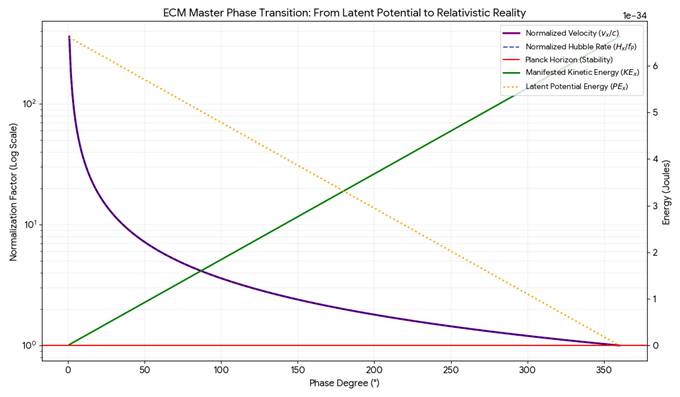
Technical Note: While the source CSV retained structural consistency, the original dataset construction inverted the frequency–energy propagation direction. The rendered visualization has been interpreted in accordance with ECM physical dynamics, correctly representing latent-to-manifest energy flow rather than relativistic back-projection.
ECM treats the sub-Planck regime as a continuous, traversable phase domain rather than a physical singularity. The 360° compactified cycle maps otherwise inaccessible scales into a calculable coordinate framework.
The universe emerges not from a Big Bang explosion but through a controlled frequency-to-energy transformation. The Planck scale functions as a stabilization boundary where pre-geometric dynamics manifest as relativistic physics.
The ECM phase-transition framework fundamentally reinterprets cosmogenesis as a continuous energetic emergence process rather than a singular explosive origin. By rendering the sub-Planck domain as a compactified, computable phase space, ECM removes the mathematical pathologies associated with singularity-based cosmological models and replaces them with a deterministic energetic evolution governed by phase progression.
A central consequence of this approach is the natural emergence of relativistic physics as a terminal stabilization condition. Instead of postulating invariant constants such as the speed of light, ECM derives them as asymptotic outcomes of deeper pre-geometric dynamics. This inversion resolves long-standing conceptual tensions between fundamental constants and early-universe physics, where conventional spacetime descriptions lose physical meaning.
The energetic transformation chain linking latent potential energy, manifested kinetic energy, and emergent matter mass provides a unified mechanism for energy conservation across cosmological scales. This continuity eliminates the need for separate inflationary triggers or exotic initial conditions, replacing them with smooth energetic redistribution governed by phase evolution.
Importantly, ECM reframes superluminal behaviors in the primordial regime not as violations of relativity but as natural features of a pre-metric domain where causal structure has not yet crystallized. Relativistic causality emerges only after phase stabilization, preserving observational consistency while extending physical accessibility into previously forbidden regimes.
From an observational perspective, the framework predicts subtle but measurable deviations in early-universe statistical structures, including modified primordial spectra and anisotropy patterns. These signatures provide concrete avenues for future empirical testing, distinguishing ECM from both standard Big Bang cosmology and inflationary extensions.
Overall, ECM offers a mathematically coherent, physically continuous, and conceptually unified description of cosmic origins. By transforming the singular origin problem into a controlled energetic phase transition, it establishes a new class of cosmological modeling in which space, time, energy, and relativistic structure arise naturally from deeper existence dynamics.
This work establishes Extended Classical Mechanics (ECM) as a continuous, sub-Planck phase-transition framework in which cosmogenesis emerges from controlled energetic transformation rather than an instantaneous singular explosion. By compactifying pre-geometric dynamics into a finite phase coordinate, ECM converts the traditionally non-computable origin problem into a tractable physical process governed by progressive manifestation of energy, mass, time, and velocity.
The phase-angle methodology demonstrates how latent energetic storage transitions smoothly into manifested kinetic reality, naturally yielding the relativistic regime as a stabilized endpoint rather than a fundamental postulate. Within this structure, time arises from cumulative phase evolution, the speed of light emerges as an asymptotic limit, and large-scale cosmological dynamics follow directly from microscopic energetic redistribution.
Beyond resolving foundational inconsistencies in conventional origin models, ECM provides a predictive program capable of connecting sub-Planck dynamics to observable cosmological signatures, including modified primordial spectra, anisotropy patterns, and emergent symmetry behavior. The framework therefore bridges conceptual physics and quantitative cosmology without invoking singularities, infinite densities, or non-physical initial conditions.
ECM redefines cosmogenesis as an energetic manifestation process governed by structured phase progression, opening a new pathway for modeling the universe from pre-metric origins to fully developed physical reality. This phase-transition approach offers a coherent and computable alternative to traditional Big Bang paradigms while remaining compatible with stabilized relativistic physics at observable scales.
Conflict of Interest (COI): The author declares no conflict of interest associated with this work.
Funding: No external funding was received for the development and publication of this research.