
|
|
Structural Boundary of Rest-Mass Cosmologies
Soumendra Nath Thakur
ORCiD: 0000-0003-1871-7803
Tagore’s Electronic Lab, India
postmasterenator@gmail.com |
postmasterenator@telitnetwork.in
January 14, 2026
Extended Classical Mechanics (ECM) has often been approached from two different historical directions. Early ECM papers introduced negative apparent mass, effective mass, and vacuum-mediated gravitation as extensions of classical dynamics. Later Phase-Kernel ECM formalized these ideas into a coherent vacuum-phase ontology, where mass, gravity, and time emerge from manifestation and demanifestation processes in the vacuum itself.
This has created the appearance that ECM has “changed.” In reality, ECM has become complete. The early formulation already contained the core physical break from conventional physics: the rejection of a single, positive rest-mass ontology and its replacement with a two-state mass system in which vacuum itself carries mass.
This document exists to make that continuity explicit. It shows how the early ECM mass definitions, dark-energy identification, and modified gravitational laws are not approximate ideas that were later replaced, but rather the first expressions of what Phase-Kernel ECM now describes precisely as vacuum-phase mass, negative apparent mass, and manifestation dynamics.
It also establishes a formal boundary between ECM and all rest-mass-based cosmologies — including those that predict matter dilution, dark-energy domination, or cosmic fading. Such models may reproduce ECM’s late-time behavior, but they cannot reproduce ECM’s physical mechanism without first adopting ECM’s mass–vacuum ontology.
In this sense, this paper is not a comparison of theories. It is a clarification of what ECM has always been.
Extended Classical Mechanics (ECM) is often compared with modified cosmologies that predict matter dilution, vacuum domination, and late-time cosmic acceleration. This comparison is physically misleading. ECM is not a rest-mass evolution theory. It is a new ontology of mass and vacuum in which gravitating matter and vacuum-phase mass exist as distinct physical states. Cosmic dissolution in ECM is a phase transfer from manifested mass to vacuum phase mass, not a decay of rest mass.
Standard physics assumes:
ECM replaces this with:
where Meff is manifested gravitating mass and Mapp is vacuum-phase mass.
Dark energy is not a field — it is stored vacuum-phase mass.
Gravity depends on how much mass is in manifested versus vacuum phase.
ECM describes phase conversion, not mass fading.
Rest-mass cosmologies reproduce ECM’s late-time behavior, but they cannot represent its physical mechanism.
No GR-based cosmology contains these variables.
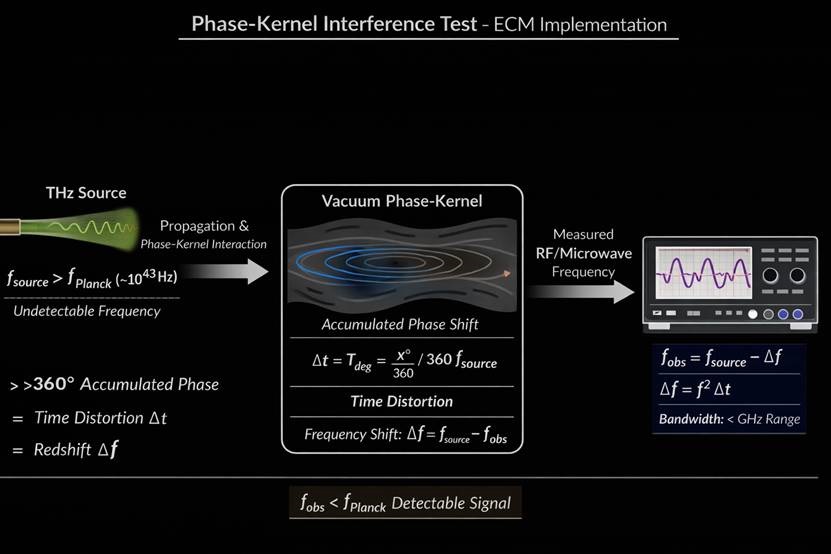
Phase-Kernel Interference Test (ECM Simulation)
This figure illustrates the experimental logic of the Phase-Kernel Interference Test, a proposed physical validation of Extended Classical Mechanics (ECM) and its vacuum-phase ontology. The diagram shows a high-frequency source (conceptually above the Planck frequency) propagating through the ECM vacuum, modeled as a phase-kernel rather than empty space.
In ECM, the vacuum is a structured medium that accumulates phase from propagating fields. As a source frequency fsource traverses the phase-kernel, it undergoes a cumulative phase rotation x°, producing a time distortion
This accumulated phase manifests observationally as a frequency shift
where the detected signal emerges at a much lower frequency fobs within the RF/microwave range, making it experimentally observable even if the original source frequency is beyond direct detection.
The right side of the figure shows the measurable output spectrum, demonstrating how an initially undetectable vacuum-coupled excitation is converted into a detectable signal by the phase-kernel interaction. This provides a direct test of ECM’s central claim: time dilation, redshift, and gravity arise from vacuum-phase accumulation rather than spacetime curvature.
Unlike conventional physics, where vacuum is inert, this experiment treats the vacuum as an active phase-storage medium. A positive detection of the predicted frequency shift would constitute empirical evidence for vacuum phase mass, manifestation dynamics, and ECM time distortion, directly supporting the Phase-Kernel formulation of gravity and cosmology.
Cosmic dissolution in ECM is not the decay of rest mass. It is the return of manifested mass into vacuum-phase mass.