
|
|
This paper develops a frequency-governed structural interpretation of cosmic expansion within the Extended Classical Mechanics (ECM) framework. The origin of the universe is described not as an explosive event into pre-existing space, but as a primordial transformation of latent phase content into manifest structure. Spatial extension emerges progressively as a consequence of ordered frequency stabilization rather than kinematic detonation.
Within this formulation, cosmic expansion represents the geometric unfolding of coordinated states indexed by emergent time. The mushroom-like analogy serves as a structural visualization of increasing lateral domain manifestation while preserving causal continuity with the primordial boundary condition. The coordinated space depicted is not curvature in the relativistic sense, but a representation of evolutionary ordering within the universal phase structure.
Time is treated as an emergent ordering parameter derived from frequency realization. Apparent rate deviations observed under gravitational or kinematic conditions are interpreted as modulation of physical process frequencies rather than intrinsic dilation of time itself. The framework remains fully consistent with empirical clock-comparison measurements while offering a distinct ontological interpretation.
At the cosmological scale, the role traditionally attributed to the cosmological constant (Λ) is reinterpreted through the manifestation relation Mᵃᵖᵖ ≡ −ΔPEᴇᴄᴍ, introducing a frequency-governed depletion mechanism that governs large-scale expansion dynamics without invoking vacuum curvature terms.
Primordial Transformation Event, Planck Era, Emergent Time, Frequency-Governed Manifestation, Apparent Mass (Mᵃᵖᵖ), −ΔPEᴇᴄᴍ, Cosmic Expansion Geometry, Process Rate Modulation, ECM Framework,
The geometric expansion framework developed here is the macroscopic consequence of the phase-indexed velocity stabilization mechanism formally derived in “Planck Epoch Through the Phase-Indexed Velocity Stabilization Lens of Extended Classical Mechanics (ECM)” (DOI: 10.5281/zenodo.18725040 ).
The diagram is constructed within a Cartesian coordinate framework. The origin represents the primordial transformation event — not an explosion within pre-existing space, but the transition from a non-eventual, unmanifested state into frequency-driven manifested existence.
Space and time do not precede this event. They originate simultaneously with the transformation. There is no temporal "before" the origin.
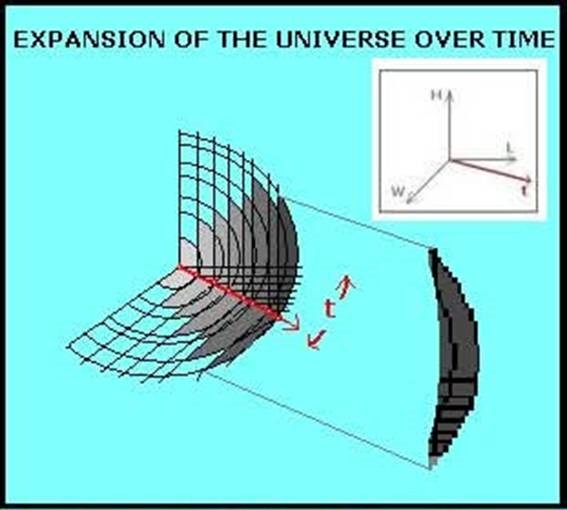
The curved grid emerging from the origin represents the progressive realization of three-dimensional spatial structure. It is neither a solid cone nor a spherical explosion. Instead, it represents the growing domain of manifested existence.
The curvature indicates structural expansion — not motion into an external medium.
The red arrow extending from the origin represents the directional ordering of events. Time emerges as a structural parameter of manifestation. It is not a pre-existing container.
Clock rate variations correspond to environmental modulation of physical processes, not intrinsic stretching of time itself.
The expanding manifested domain resembles the cap of a mushroom. This analogy is purely geometric and structural. It does not imply explosive mechanics, nor does it represent matter expanding into a pre-existing spatial void.
As manifestation progresses:
Importantly, the coordinated space shown in the representation does not depict curvature of space in the relativistic sense. The geometry is not an embedding diagram of spacetime distortion. Rather, the coordinated axes represent the structural ordering of universal evolution with respect to emergent time.
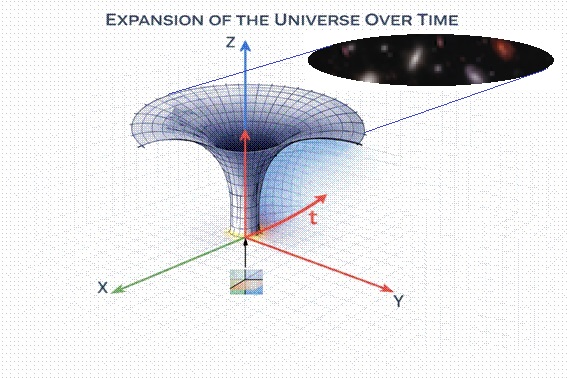
The universe does not move outward into pre-existing space. Instead, the expanding boundary represents forward progression in emergent time. The origin persists as a causally inactive historical boundary within the ordered history of manifestation.
Within this framework:
Gravitational and kinematic conditions alter process frequency. They do not require intrinsic stretching of time as a fundamental entity.
Physics measures process rates; interpretation assigns ontological meaning. The ECM framework maintains this distinction explicitly.
The foregoing replacement of the cosmological constant by NAM (Mᵃᵖᵖ ≡ −ΔPEᴇᴄᴍ) acquires deeper structural meaning when situated within the foundational logic of the ECM Phase Kernel. The expansion term is not an isolated cosmological adjustment but a direct consequence of the primordial phase-redistribution mechanism.
This work develops a frequency-governed interpretation of cosmic expansion within the Extended Classical Mechanics (ECM) framework. Rather than introducing a cosmological constant (Λ) as an independent geometric term, the present method identifies cosmic expansion as a direct consequence of latent potential transformation within a dual-domain conservation structure.
The central methodological replacement is defined as:
NAM (Mᵃᵖᵖ) ≡ −ΔPEᴇᴄᴍ
Here, apparent mass (Mᵃᵖᵖ) represents the manifest expression of latent potential depletion in the ECM domain. The expansion-driving term is therefore not externally imposed but arises intrinsically from transformation dynamics.
Within ECM, manifestation follows the conservation-linked transformation:
ΔPEᴇᴄᴍ ↔ ΔKEᴇᴄᴍ ↔ ΔMᴍ
The depletion of latent potential (−ΔPEᴇᴄᴍ) manifests as apparent mass:
Mᵃᵖᵖ ≡ −ΔPEᴇᴄᴍ
Cosmic expansion is therefore governed by progressive redistribution of latent potential rather than by insertion of a constant vacuum-energy density term.
In conventional cosmological modeling, expansion is proportional to Λ. In the present framework, this proportionality is structurally replaced by:
Expansion ∝ Mᵃᵖᵖ
This replacement carries the following implications:
Acceleration emerges from frequency-governed depletion of latent potential rather than from a constant background pressure.
The expansion process follows a causal sequence:
Expansion is therefore:
Within this method:
The cosmological constant is therefore not denied but reinterpreted structurally:
Λ → Mᵃᵖᵖ ≡ −ΔPEᴇᴄᴍ
This framework:
Mᵃᵖᵖ = −ΔPEᴇᴄᴍ
Structural Expansion Term in Extended Classical Mechanics
The structural replacement of the cosmological constant by NAM (Mᵃᵖᵖ ≡ −ΔPEᴇᴄᴍ) is fully consistent with the ECM Phase Kernel model, in which all manifestation originates from a conserved zero-dimensional phase reservoir.
Within the Phase Kernel formulation, the primordial state contains undifferentiated phase-content without spatial extension. Spatial structure emerges only through frequency-governed redistribution of latent potential. This redistribution is governed by the identity:
ΔPEᴇᴄᴍ ↔ ΔKEᴇᴄᴍ ↔ ΔMᴍ
As latent potential is progressively depleted, the negative gradient −ΔPEᴇᴄᴍ manifests as apparent mass Mᵃᵖᵖ. In the cosmological context, this manifestation generates structural expansion gradients across the coordinated domain. The role attributed conventionally to Λ is therefore internally fulfilled by the Phase Kernel transformation process itself.
Cosmic expansion, in this interpretation, is not driven by an externally imposed vacuum constant but by intrinsic phase redistribution emerging from the Kernel. The widening spatial domain reflects progressive manifestation, while the governing driver remains conservation-consistent:
Mᵃᵖᵖ = −ΔPEᴇᴄᴍ
Thus, the Phase Kernel provides the ontological foundation for the emergent expansion term, unifying gravitation, manifestation, and cosmological growth within a single frequency-regulated conservation framework.
The geometric model developed in this work interprets cosmic expansion as a frequency-governed manifestation emerging from a primordial transformation of latent phase content. The expanding domain is not treated as the aftermath of an explosive detonation into pre-existing space, but as the progressive realization of coordinated structure indexed by emergent time. The mushroom-like analogy serves as a structural visualization of this ordered unfolding rather than a mechanical description.
Within the Extended Classical Mechanics (ECM) framework, the cosmological expansion term is not introduced as an externally imposed constant. Instead, the role traditionally attributed to the cosmological constant is structurally reinterpreted through the manifestation identity:
Mᵃᵖᵖ ≡ −ΔPEᴇᴄᴍ
Cosmic acceleration thus arises from conservation-consistent redistribution of latent potential rather than from vacuum energy density or geometric curvature terms. Expansion is understood as an intrinsic consequence of phase-governed transformation dynamics.
Clock-comparison measurements and precision timing experiments remain fully respected within this interpretation. Observed rate deviations are attributed to environmental modulation of physical processes, not to intrinsic dilation of time as an ontological entity. The distinction advanced here is therefore theoretical rather than empirical.
If the ECM formulation reproduces precision measurements while grounding expansion in conservation-linked phase redistribution, it constitutes a coherent alternative explanatory structure. The framework does not negate established observations; it proposes a different structural interpretation of the mechanisms underlying them.
In this view, cosmic evolution reflects ordered transformation within a conserved phase domain, unifying manifestation, gravitation, and expansion under a frequency-regulated conservation principle.
A geometric and structural continuation of this phase-indexed stabilization framework is developed in the subsequent ECM expansion analysis (DOI: 10.5281/zenodo.18725040).