
|
|
Soumendra Nath Thakur
Tagore’s Electronic Lab, India
ORCiD: 0000-0003-1871-7803
Email: postmasterenator@gmail.com | postmasterenator@telitnetwork.in
February 18, 2026
Extended Classical Mechanics (ECM) reformulates physical reality as a discrete phase-indexed manifestation of primordial frequency potential. Rather than assuming spacetime, relativistic mass–energy equivalence, or predefined propagation limits, ECM derives time, space, energy, matter, gravitation, and velocity stabilization from a single unified manifestation cascade.
Physical time emerges directly from fractional phase realization of stabilized frequency, while potential energy forms as stored manifested frequency. Dynamic conversion of this potential produces kinetic energy and matter (ΔMᴍ), whereas the unmanifested residual acts as effective gravitational mass (Mᵉᶠᶠ = Mɢ). Dark components arise naturally as manifestation deficits without invoking exotic substances.
The propagation velocity follows directly from phase-indexed wavelength and emergent time, yielding a natural super-phase regime at early manifestation and deterministic convergence toward the equilibrium constant c = ℓᴘ fᴘ without postulation. This mechanism predicts early superluminal expansion as a manifestation process rather than spacetime inflation.
Continued manifestation depletes the gravitational potential reservoir, producing a finite termination scale rₘₐₓ beyond which bound structures cannot persist, corresponding observationally to the zero-gravity radius of galaxy systems.
ECM therefore provides a singularity-free, conservation-governed foundation in which time, mass, gravity, cosmic expansion, and velocity limits emerge coherently from phase-indexed frequency manifestation.
Extended Classical Mechanics; phase-indexed manifestation; emergent time; frequency-to-energy transformation; matter formation; gravitational reservoir; velocity stabilization; superluminal pre-physical regime; rₘₐₓ gravitational termination; dark energy emergence; unified conservation dynamics
Modern fundamental physics rests upon assumptions introduced to reconcile observational limits with theoretical structure, most notably the postulation of spacetime as a primary entity, relativistic mass–energy equivalence, invariant light speed as an axiom, and dark components introduced to preserve gravitational consistency. While successful phenomenologically, these frameworks do not derive time, space, gravitation, or cosmic expansion from a unified physical mechanism.
Extended Classical Mechanics (ECM) is developed as a principle-based alternative in which physical reality emerges from discrete phase-indexed manifestation of primordial frequency potential. Rather than assuming propagation limits, spacetime geometry, or intrinsic mass–energy equivalence, ECM derives all observable structures through conservation-governed transformation of manifested and unmanifested frequency.
In this framework, physical time arises as a direct outcome of phase realization. Space emerges as stabilized wavelength separation. Energy forms as manifested frequency storage, and matter appears through potential-to-kinetic conversion governed by:
The residual unmanifested potential functions as effective gravitational mass Mᵉᶠᶠ = Mɢ, naturally producing gravitational attraction without requiring curvature of spacetime or relativistic mass constructs.
Velocity is not postulated as invariant. Instead, it emerges from phase-indexed wavelength evolution and physical time formation. Early manifestation yields a non-physical super-phase regime in which v ≫ c, followed by deterministic stabilization toward the equilibrium constant:
This mechanism naturally predicts early superluminal cosmic expansion as a manifestation process rather than spacetime inflation.
As manifestation proceeds, the gravitational potential reservoir depletes continuously. This depletion produces a finite gravitational termination scale rₘₐₓ at which bound systems can no longer exist. Beyond this limit, effective antigravitational dominance emerges without invoking exotic dark substances.
The purpose of this paper is to present the ECM phase-indexed manifestation framework in a mathematically consistent and physically intuitive manner, demonstrating how time, space, velocity stabilization, gravitation, matter formation, cosmic expansion, and large-scale structure termination arise from a single conserved frequency transformation principle.
Subsequent sections derive the discrete phase cascade, velocity stabilization law, manifestation-driven gravitational dynamics, and the natural emergence of the cosmic termination radius, establishing ECM as a unified classical foundation free from singularities and postulated relativistic constraints.
The methodological foundation of Extended Classical Mechanics (ECM) is the principle that all physical observables emerge from discrete manifestation of conserved primordial frequency potential. Rather than postulating spacetime, invariant velocity, or intrinsic mass–energy equivalence, ECM derives these quantities through phase-indexed transformation governed by conservation of total existence.
The approach proceeds through four core steps: (i) phase discretization of manifestation, (ii) emergence of physical time, (iii) wavelength stabilization and velocity formation, and (iv) transformation of potential into kinetic and matter content.
Manifestation is treated as a cyclic phase process indexed by angle x°, where each phase corresponds to a fractional realization of total frequency potential. A complete manifestation cycle spans 360°, defining the fundamental emergence interval.
where Tₓ° represents the physical time accumulated up to phase x°, and f₀ is the stabilized manifestation frequency. At full cycle completion:
establishing Planck-scale temporal emergence as a direct consequence of phase realization.
The primordial frequency reservoir initially exists entirely as stored potential energy PEᴇᴄᴍ. As phase manifestation proceeds, a portion converts into kinetic form, generating matter through conservation:
The remaining unmanifested component constitutes the effective gravitational mass:
This residual potential governs gravitational interaction without invoking spacetime curvature or relativistic mass constructs.
Each manifestation phase produces a corresponding wavelength λ₀,x° associated with the emerging frequency f₀,x°. Early phases yield sub-Planck wavelengths and super-Planck frequencies, forming a non-physical pre-stabilization regime.
The instantaneous propagation speed follows directly from:
As phase index approaches 360°, wavelength increases toward ℓᴘ while frequency decreases toward fᴘ, producing deterministic stabilization:
This replaces postulated invariant light speed with a dynamically derived equilibrium limit.
Continuous conversion of PEᴇᴄᴍ into manifested matter progressively reduces the gravitational reservoir Mᵉᶠᶠ. This process naturally defines a finite termination scale rₘₐₓ at which effective gravitational binding vanishes:
Beyond this radius, manifested dynamics dominate and no bound gravitational system can persist.
All derived relations are evaluated through discrete phase stepping from x° = 1° to 360°, generating full phase-resolved datasets for wavelength, frequency, velocity, energy transformation, and gravitational depletion.
This discrete cascade approach ensures conservation consistency while permitting continuous-limit interpretation where appropriate. Numerical tables and stabilization curves are produced directly from the governing equations without phenomenological fitting.
Together, these methods establish ECM as a closed, derivation-based physical framework in which all observables arise from conserved frequency manifestation rather than postulated spacetime or relativistic constructs.
To formalize the discrete realization of manifestation in Extended Classical Mechanics, the emergence process is indexed by angular phase x° ∈ [0°, 360°], representing progressive transformation of primordial frequency potential into stabilized physical observables.
Each phase step corresponds to the simultaneous evolution of frequency, wavelength, velocity, and energy while conserving total existence:
This directly defines physical time as a manifestation outcome rather than a fundamental background quantity.
The stabilized boundary corresponds to Planck-scale observables fᴘ and ℓᴘ. The continuous-limit phase evolution follows:
As manifestation completes:
Early manifestation satisfies:
producing a natural pre-stabilization superluminal expansion regime.
where progressive manifestation converts stored potential into matter while depleting the gravitational reservoir.
For computational realization, the system may be discretized into integer phase steps:
| x° | Δtₓ° | f₀ₓ° | λ₀ₓ° | v₀ₓ° | KEᴇᴄᴍ | PEᴇᴄᴍ |
|---|---|---|---|---|---|---|
| 0 | 0 | fᵤ | ≈ 0 | ≈ 0 | 0 | Max |
| 1 | Δt₁° | f₀₁° | λ₀₁° | v₀₁° | ↑ | ↓ |
| ⋮ | ⋮ | ⋮ | ⋮ | ⋮ | ⋮ | ⋮ |
| 360 | tᴘ | fᴘ | ℓᴘ | c | Max | 0 |
The phase-indexed cascade describes a continuous transformation from non-physical primordial frequency dominance to stabilized classical reality. Velocity stabilization, matter formation, gravitational depletion, and temporal emergence arise simultaneously through conservation-governed manifestation.
No invariant propagation speed, spacetime geometry, or singular origin is assumed - all observables emerge dynamically.
Having established the general phase-indexed mathematical structure governing frequency evolution, wavelength emergence, velocity formation, and energy conservation in ECM, we now examine how each physical observable arises explicitly from this manifestation cascade. The following sections apply the formal relations to derive the emergence of physical time, discrete frequency stabilization, energy-to-matter conversion, gravitational potential formation, velocity convergence, and large-scale termination behavior. Together, these results demonstrate how all classical and cosmological structures originate directly from phase-driven frequency realization without introducing external spacetime postulates or singular origins.
In Extended Classical Mechanics (ECM), time is not fundamental but emerges through progressive manifestation of stabilized frequency. A complete realization corresponds to a 360° phase cycle.
Thus, fractional phase realization directly produces emergent physical time. Upon full cycle completion:
Planck time is therefore a manifestation result, not a pre-imposed limit.
Primordial frequency exists initially in an unobservable state and becomes physical only after a complete manifestation cycle.
Physical frequency therefore emerges discretely through phase completion.
Stabilized frequency stores ECM potential energy:
Primordial frequency drives dynamic transformation:
Matter thus emerges directly from energy manifestation.
Not all stabilized energy manifests immediately:
Stored unmanifested potential acts as gravitational mass.
Apparent dark phenomena arise naturally as manifestation deficits.
Existence is conserved through manifestation partitioning.
Time arises from cyclic frequency realization, matter from dynamic energy conversion, and gravity from residual stored potential. No singularities or relativistic constructs are required.
Existence evolves through discrete phase-driven manifestation of primordial frequency.
In ECM, propagation speed is not a predefined limit but emerges naturally from the phase-indexed manifestation of frequency. Since physical time arises from stabilized frequency realization:
Spatial manifestation proceeds through discrete wavelength formation. Let λ represent the manifested distance associated with a given phase state. Instantaneous propagation velocity is therefore:
Substituting the emergent time relation:
During early manifestation, phase completion is small and wavelength is large, yielding non-physical super-phase velocities. As manifestation proceeds:
At full stabilization:
The stabilized frequency–wavelength equilibrium defines the universal propagation constant:
Thus velocity naturally converges to:
Any additional manifestation energy does not increase propagation speed but is redirected into matter creation and stored potential:
Velocity saturation is therefore a direct consequence of ECM manifestation conservation.
The speed of light is not imposed as a spacetime constraint but arises as the equilibrium outcome of completed frequency-phase realization.
In ECM, propagation velocity emerges from the phase-indexed manifestation of wavelength and frequency. Since physical time arises from stabilized frequency:
Manifested spatial progression is represented by the phase-resolved wavelength λ₀,ₓ°. Instantaneous velocity therefore follows:
During early phase emergence, ECM manifestation produces:
Hence each phase-resolved velocity satisfies:
Thus, prior to full manifestation completion, velocities naturally exceed the stabilized equilibrium value due to simultaneously compressed spatial scales and elevated primordial frequencies.
As phase realization progresses:
At complete stabilization:
The propagation velocity therefore converges smoothly from super-phase values to the ECM equilibrium constant.
Any further manifestation energy does not increase velocity but is redirected into matter creation and stored potential:
Super-luminal values occur only in the pre-physical manifestation regime. Once full phase realization is achieved, velocity stabilizes uniquely at c through ECM energy partitioning.
In Extended Classical Mechanics, neither time nor space exists fully at the earliest manifestation stages. Both emerge progressively as primordial frequency unfolds through discrete phase realization.
At early phases:
Since velocity is defined as manifested distance divided by emergent time, these combined effects naturally generate propagation values far exceeding the stabilized equilibrium constant. This super-phase regime does not represent motion through formed spacetime but a pre-physical manifestation process in which both space and time are still taking shape.
As manifestation progresses, wavelength expands, frequency relaxes, and phase approaches completion. Their product converges smoothly toward a unique equilibrium:
Beyond this point, additional manifestation energy no longer increases velocity but converts into matter and stored gravitational potential, enforcing automatic speed saturation.
The speed of light therefore emerges as a manifestation equilibrium rather than a postulated universal limit.
In Extended Classical Mechanics, the gravitational influence of a system is governed by the remaining stored potential following manifestation, identified as the effective gravitational mass:
As manifestation progresses and ΔPEᴇᴄᴍ increases through matter formation (ΔMᴍ), the remaining gravitational reservoir continuously decreases. When this reservoir becomes exhausted, gravity can no longer sustain bound structures. This defines a natural gravitational termination radius:
This ECM termination scale corresponds directly to the zero-gravity radius as shown by Chernin A.D. and collaborators in their analysis of Coma galaxy clusters. Beyond this radius, repulsive cosmic effects dominate over gravitational attraction, preventing further bound structure.
In their Newtonian formulation including dark-energy background effects, the radial acceleration of a test mass at distance R is:
The gravitational pull of matter balances the repulsive dark-energy term when:
This radius marks the maximum scale at which gravity can bind matter. Inside Rᴢɢ, matter gravity dominates; beyond Rᴢɢ, effective antigravity dominates and bound systems cannot exist. Observations of the Coma Cluster indicate a termination scale on the order of tens of megaparsecs.
Within ECM, this same boundary arises not from an external dark-energy force, but from depletion of the gravitational potential reservoir through manifestation:
Thus the observational zero-gravity radius corresponds physically to ECM’s manifestation-driven gravitational exhaustion scale. What appears phenomenologically as antigravity is, in ECM, the absence of remaining stored potential capable of producing attraction.
The complete ECM evolution follows a discrete phase-indexed manifestation sequence from primordial frequency potential to stabilized physical reality. Each phase increment produces simultaneous emergence of time, space, energy partition, mass formation, gravitational storage, and velocity convergence.
At zero phase realization, existence remains entirely unmanifested and physically unobservable.
Time begins to emerge, spatial scales remain highly compressed, frequency remains elevated, and rapid energy conversion initiates matter formation while gravitational potential remains dominant.
Matter accumulates while stored gravitational potential forms the structural backbone of cosmic organization. Propagation velocity continuously decreases toward equilibrium.
Physical spacetime is fully established, propagation stabilizes, matter exists dynamically, and gravity operates as stored unmanifested potential.
Ongoing manifestation steadily converts stored potential into matter, weakening gravitational capacity until a finite termination radius is reached where gravity can no longer operate.
All physical structures in ECM arise from a single phase-indexed frequency manifestation cascade without singularities or externally imposed limits.
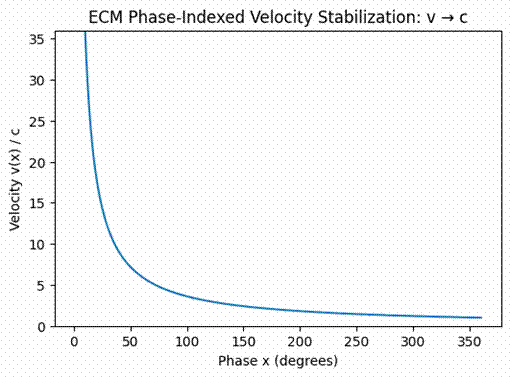
Figure: Phase-indexed velocity evolution in ECM. Early phase exhibits superluminal pre-manifestation motion (v ≫ c), followed by continuous decay and exact stabilization toward v = ℓᴘ fᴘ = c as phase approaches 360°.
In the early phase regime (x° ≪ 360°), wavelength remains far below the Planck length:
λ₀,x ≪ ℓᴘ
while frequency remains far above the Planck frequency:
f₀,x ≫ fᴘ
Thus the phase-indexed propagation velocity becomes:
v₀,x = f₀,x λ₀,x ≫ c
This superluminal regime is not physical motion through spacetime, but a manifestation-speed during frequency–mass emergence prior to stabilization.
As phase accumulates toward 360°:
forcing the velocity to converge uniquely toward:
v → ℓᴘ fᴘ = c
The ECM phase-indexed frequency manifestation process inherently predicts:
What is interpreted phenomenologically as cosmological inflation corresponds physically to the deterministic stabilization of manifestation velocity during early frequency-to-mass conversion.
No exotic fields, vacuum energy patches, or spacetime singularities are required - inflation arises directly from ECM phase dynamics.
The phase-indexed manifestation framework of Extended Classical Mechanics (ECM) demonstrates that time, space, velocity, matter, gravitation, and large-scale cosmic structure arise from a single conserved frequency transformation process rather than independent postulates. Unlike conventional formulations that impose spacetime geometry, invariant propagation speed, or relativistic mass–energy equivalence, ECM derives each observable as an emergent outcome of discrete manifestation.
The velocity stabilization curve (Figure 15) illustrates a central result of the theory: propagation speed is not fundamental but evolves dynamically. Early manifestation produces a super-phase regime characterized by extremely compressed spatial scales and elevated primordial frequencies, naturally yielding v ≫ c. As phase realization progresses, wavelength expansion and frequency relaxation enforce continuous convergence toward the equilibrium value v = ℓᴘ fᴘ = c.
This mechanism replaces postulated cosmic inflation with a deterministic manifestation-driven expansion process. Rapid early expansion, smooth decay, and final stabilization emerge automatically from conservation of frequency potential. No exotic vacuum fields, spacetime singularities, or fine-tuned parameters are required.
Matter formation follows directly from the same conservation structure through:
Simultaneously, the residual unmanifested component functions as the gravitational reservoir:
Thus gravity is not an independent geometric property but the physical effect of stored manifestation potential. As conversion proceeds, this reservoir depletes naturally, producing a finite gravitational termination scale rₘₐₓ. What appears observationally as antigravitational dominance corresponds in ECM to exhaustion of the remaining gravitational potential.
A key conceptual shift introduced by ECM is that fundamental constants are not imposed boundaries but stabilized equilibrium outcomes. Planck time arises from full phase completion, Planck length from wavelength stabilization, and the speed of light from frequency–wavelength balance. Beyond stabilization, additional energy does not alter propagation but converts into matter and stored gravitational potential, enforcing automatic saturation without requiring relativistic constraints.
The unified phase cascade:
demonstrates that all physical structure emerges from a single conserved manifestation principle. Time, space, inertia, gravity, and cosmic limits are not separate assumptions but interconnected outcomes of frequency realization.
Importantly, ECM remains fully classical in structure while reproducing stabilized Planck-scale limits dynamically. No singular origins are required; the primordial state is a non-physical frequency reservoir that becomes physical only through manifestation. This resolves divergences associated with infinite densities, instantaneous creation, and imposed spacetime emergence.
The framework further provides clear observational implications:
Future work will extend the phase-indexed formalism to detailed galactic rotation profiles, cosmological structure distributions, and time-evolution of manifestation depletion to enable direct comparison with observational datasets.
Extended Classical Mechanics thus offers a unified, conservation-based origin of physical reality in which all observables emerge from phase-driven frequency manifestation without spacetime postulates, relativistic mass constructs, or dark-sector assumptions.
This work has presented Extended Classical Mechanics (ECM) as a unified, principle-based framework in which all physical observables emerge from discrete phase-indexed manifestation of conserved primordial frequency potential. Rather than assuming spacetime, invariant propagation speed, relativistic mass–energy equivalence, or dark components, ECM derives time, space, velocity, matter, gravitation, and cosmic structure directly from conservation-governed transformation.
Physical time arises as a manifestation outcome of phase realization. Spatial separation emerges through stabilized wavelength formation. Energy appears as manifested frequency storage, while matter forms through continuous conversion governed by:
The remaining unmanifested reservoir naturally functions as gravitational mass:
Velocity is shown to evolve dynamically from phase-indexed wavelength and emergent time, producing a natural super-phase expansion regime followed by deterministic stabilization toward:
This replaces postulated light-speed invariance and cosmological inflation with a single manifestation-driven stabilization process.
Ongoing energy conversion progressively depletes the gravitational reservoir, yielding a finite termination radius rₘₐₓ beyond which bound structures cannot persist. What appears phenomenologically as antigravitational dominance arises physically as exhaustion of stored manifestation potential.
The complete ECM evolution follows a unified cascade:
demonstrating that time, space, inertia, gravity, cosmic expansion, and structural limits originate from a single conserved manifestation principle.
By eliminating singular origins, imposed spacetime geometry, and independent dark-sector assumptions, ECM offers a continuous, physically intuitive foundation for both microscopic and cosmological dynamics. Fundamental constants emerge as stabilized equilibrium outcomes rather than axiomatic boundaries.
The framework provides clear predictive avenues, including manifestation-driven expansion histories, finite gravitational influence scales, and direct linkage between matter formation and gravitational strength. Future developments will extend the phase-indexed formalism to detailed astrophysical and cosmological comparisons.
Extended Classical Mechanics establishes a closed classical origin of physical reality in which all observable structure emerges through discrete frequency manifestation governed solely by conservation of existence.