
|
|
Soumendra Nath Thakur
ORCiD: 0000-0003-1871-7803
Tagore's Electronic Lab, India
postmasterenator@gmail.com | postmasterenator@telitnetwork.in
Date: March 31, 2026
This manuscript establishes a phase-driven transformational framework within Extended Classical Mechanics (ECM), in which phase is interpreted as a generalized displacement directly governing energy manifestation rather than being constrained by spatial motion. ECM separates phase-mediated transformation from conventional spatial propagation, allowing phase velocity (vphase) to exceed c without violating causality, as it represents transformation dynamics rather than physical transport. A formal relation between phase progression, wavelength, and frequency introduces a threshold frequency (fc) delineating sub-luminal and superluminal transformation regimes. By applying the ECM manifestation principle (ΔPEᴇᴄᴍ → ΔMᴍ → ΔKEᴇᴄᴍ), high-frequency domains enable rapid energy–mass transformation through phase evolution. The framework further defines an anti-gravitational domain, where dominant negative apparent mass (−Mᵃᵖᵖ) decouples transformation from spatial constraints, producing enhanced transformation intensity. This approach unifies frequency-governed phase dynamics with the ECM congestion factor (kᴇᴄᴍ), providing a coherent, physically grounded interpretation of superluminal behavior as a manifestation of phase-driven transformation rather than actual motion. Overall, the work extends classical mechanics into regimes traditionally considered beyond its scope while preserving determinism, causality, and physical intuition.
In Extended Classical Mechanics (ECM), phase is treated as a generalized displacement physically tied to energy manifestation, rather than being constrained by spatial motion limits. While conventional physics limits motion by c, ECM distinguishes:
Each full cycle corresponds to wavelength λ, emerging from frequency via E = h f, making λ a physical manifestation of energy.
Where:
This replaces conventional Δφ = (2πΔL)/λ, removing radian restriction and enabling phase extension beyond 360°.
| Symbol | Definition | Role |
|---|---|---|
| k_λ | 360° / λ | Geometric phase–length proportionality |
| kᴇᴄᴍ | Dynamic congestion factor | Phase-kernel transformation intensity |
| k | h(fᴘ / f₀) | Pre-Planck proportionality constant |
Real-world correspondence:
When -Mapp ≫ Mᴍ:
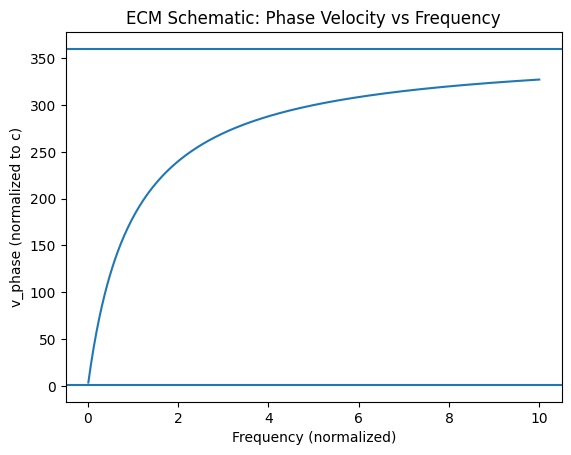
| Frequency Regime | λ | v(x°) | vphase | Behaviour |
|---|---|---|---|---|
| High-frequency | Very small | Very small | ~360 c | Superluminal transformation |
| Low-frequency | Large | Large | ≤ c | Sub-luminal transformation |
Within the Extended Classical Mechanics (ECM) framework, the congestion factor kᴇᴄᴍ is not derived from geometric wave relations, but is treated as a dynamically emerging parameter linked to phase-driven transformation intensity. It is therefore fundamentally distinct from wavelength-based proportionality.
In ECM, the geometric phase–displacement relation is independently governed by:
which defines the proportionality between linear displacement and phase (x°). This geometric factor must not be conflated with the congestion factor.
To maintain internal consistency, ECM distinguishes three independent proportionality terms:
Only kᴇᴄᴍ governs Phase-Kernel simulation dynamics.
The congestion factor represents the degree of phase accumulation and transformation coupling within the ECM framework:
It does not originate from vphase / λ, and therefore removes the inconsistency present in classical wave-number formulations.
At the critical transition boundary (fc), ECM defines a reference transformation state rather than a strict velocity constraint:
This reflects that phase progression is governed by wavelength manifestation rather than constrained angular rotation.
For simulation purposes, kᴇᴄᴍ may be expressed in normalized form relative to a critical transformation state:
This formulation ensures:
Although ECM prioritizes wavelength as the physically manifesting quantity, frequency governs the rate at which phase cycles are generated. Accordingly:
Thus, frequency determines temporal evolution, while wavelength governs spatial manifestation.
Within this framework, kᴇᴄᴍ represents the intensity of phase-driven transformation, directly influencing:
Thus, kᴇᴄᴍ is not a geometric or externally imposed parameter, but an emergent quantity governed by transformation dynamics within the ECM framework.
Within the Extended Classical Mechanics (ECM) framework, phase emerges as the primary driver of transformation, independent of spatial motion constraints. This separation allows the universal velocity limit (c) to govern only physical displacement, while transformation dynamics mediated by phase and frequency can exceed this limit without violating causality. The introduction of a critical frequency threshold (fc) establishes a natural boundary between sub-luminal (gravitationally constrained) and superluminal (transformation-dominant) regimes. In high-frequency domains, rapid phase evolution facilitates efficient conversion of potential energy into matter mass and kinetic manifestation (ΔPEᴇᴄᴍ → ΔMᴍ → ΔKEᴇᴄᴍ), consistent with the ECM manifestation principle. Dominant negative apparent mass (−Mᵃᵖᵖ) creates an anti-gravitational domain, allowing transformation dynamics to dominate over spatial limitations, with the congestion factor (kᴇᴄᴍ) emerging as a frequency-governed measure of phase-driven transformation intensity. In essence, ECM frames the universe as a deterministic, phase-indexed system where frequency governs transformation, space–time constraints are emergent, and superluminal phenomena naturally arise from high-frequency phase evolution rather than physical motion, unifying energy, mass, and phase dynamics into a coherent transformational framework.