
ECM Unified Phase–Time–Frequency Law with Boundary Perturbation Interpretation
Abstract
This work derives a closed-form phase–time–frequency mapping and demonstrates that gravitational interaction emerges as a gradient of phase–frequency imbalance, eliminating the need for fundamental spacetime constructs. Within the framework of Extended Classical Mechanics (ECM), a unified formulation of phase shift, time displacement, frequency evolution, and energy variation is developed. Building upon phase-indexed derivations of mass emergence, gravitational coupling, and Planck-scale frequency dynamics, the present work integrates boundary perturbation theory with cosmological frequency-cycle structure to establish a single coherent phase–time–frequency law.
A reference oscillatory cycle is defined as a complete and unperturbed 360° phase structure, serving as the invariant baseline of physical evolution. Phase shift is interpreted not as an internal deformation of the cycle but as a boundary-induced perturbation that alters the initialization condition of successive cycles. This mechanism produces measurable temporal displacement governed by the relation
From this foundation, frequency variation arises naturally as a secondary response to phase displacement, yielding the transformation laws
The framework further connects phase evolution to effective mass formation and gravitational coupling, where frequency gradients generate emergent inertia and spacetime curvature analogues. In this context, gravitational interaction is reinterpreted as a manifestation of phase-frequency imbalance across boundary transitions between cycles.
By unifying boundary perturbation theory, Planck-scale frequency normalization, and cosmological phase cycling, this work establishes ECM as a consistent phase–frequency ontology in which time, mass, energy, and gravitation emerge as derivative properties of conserved phase evolution rather than independent fundamental constructs.
Conceptual Bridge to Phase-Indexed Cosmological Framework:
The unified phase–time–frequency formulation presented in the abstract naturally extends into a broader cosmological structure in which phase evolution governs not only local temporal and energetic displacement, but also large-scale cosmic dynamics. The boundary perturbation mechanism that generates Δt and Δf at the cycle level becomes, at higher scales, the organizing principle for the emergence of mass distribution, spacetime structure, and gravitational interaction.
In this extended interpretation, the same phase-indexed transition rules that define time displacement at the oscillatory level are generalized to Planck-scale and cosmological regimes. The 360° cycle ceases to be a purely local oscillatory construct and instead functions as a fundamental unit of cosmological evolution, within which velocity stabilization, frequency redistribution, and mass emergence occur as coordinated phase-dependent processes.
This provides a direct conceptual pathway from the boundary perturbation formalism of the abstract to the broader ECM cosmological framework, where physical reality is interpreted as a hierarchical sequence of phase-indexed transformations spanning from microscopic oscillations to cosmic-scale structure formation.
Introduction
The reference cycle occurs without any phase shift (x° = 0); it is an unaltered 360° cycle—λ₀°, λ₁°, λ₂°...λ₃₅₉°, or T₀°, T₁°, T₂°...T₃₅₉°—into which nothing has intervened. The reference cycle does, in fact, occupy specific physical states; it is only after this that any deviation occurs.
A phase shift constitutes a transition from a prior reference state to a new, altered state. This change should not be attributed to the reference state itself; rather, it belongs to the subsequent cycle that emerges after completion of the reference evolution.
The reference cycle—λ₀°, λ₁°, λ₂°...λ₃₅₉°, or T₀°, T₁°, T₂°...T₃₅₉°—serves as the baseline standard and must remain undisturbed. Upon completion, the oscillation is expected to restart from λ₀° (equivalently λ₃₆₀°). However, at this precise boundary, an external perturbation may occur.
This perturbation alters the initialization of the next cycle such that the λ₀° or T₀° segment is not realized, and the cycle instead begins at a displaced phase position. For example, a 1° phase shift results in λ₀°⟶λ₁° and T₀°⟶T₁°, thereby shifting the entire cycle forward.
The relation:
demonstrates that any phase shift directly produces a temporal displacement. This temporal displacement modifies the effective oscillation period and leads to a measurable frequency deviation. Consequently, a phase shift induces a small energy variation given by:
Thus, phase shift acts as the fundamental mechanism governing temporal, frequency, and energy transformations.
Figure X: ECM Phase-Shift Reference to Altered States
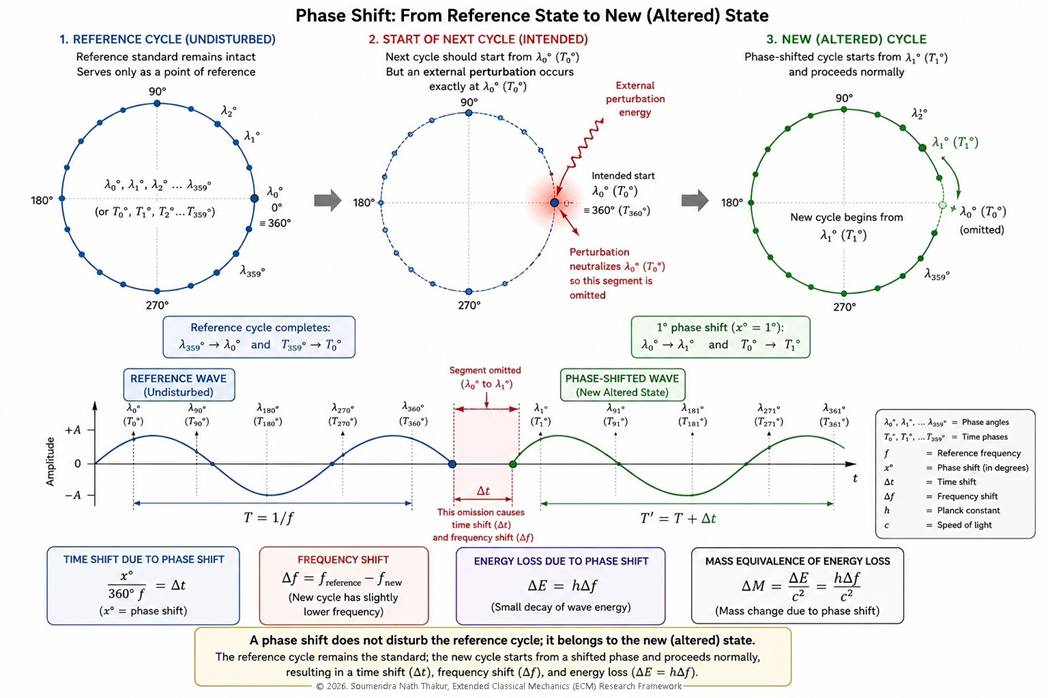
Figure X. Phase-shift transition from a reference ECM cycle to altered existential states.
Description
The figure illustrates the concept of a phase shift as a transition mechanism within the ECM framework, where a system evolves from a reference cyclic state into a sequence of altered or transformed states. The reference cycle is represented as a closed and unperturbed 360° loop, signifying a stable baseline configuration without internal state deformation.
A phase shift introduces a discontinuity in this cyclic invariance, producing a transition from one state manifold to another. The resulting altered states represent successive reconfigurations of the system’s internal structure, interpreted in ECM as changes in effective mass distribution, entropic ordering, and state accessibility.
In this interpretation, the reference state remains structurally invariant, while the phase shift acts as the governing operator of transition. The altered states are therefore not deformations of the reference cycle, but new existential configurations derived from phase re-mapping.
ECM Interpretation
This figure supports the ECM principle that physical evolution is governed by discrete phase transitions rather than continuous deformation. A reference cycle (0°–360°) represents a conserved structural domain, while a non-zero phase shift (Δφ ≠ 0) defines a transition operator between distinct state manifolds.
Mathematical Representation (ECM Form)
Reference Cycle: λ₀° → λ₃₅₉°

Phase Shift Operator: Δφ ≠ 0

State Transition: S_ref → S_altered

ECM Mapping: -ΔPEᴇᴄᴍ ↔ ΔMᴍ ↔ state transformation
Methodology: Phase–Boundary Perturbation and Frequency-Derived Formalism
The methodology of this work is fundamentally constructive, phase-indexed, and derivational, operating within the Extended Classical Mechanics (ECM) framework. Rather than adopting empirical curve-fitting or postulated spacetime structures, the present approach builds all physical relations from a single invariant construct: the unperturbed 360° phase cycle.
The central objective is to demonstrate that time displacement (Δt), frequency variation (Δf), and energy transformation (ΔE) emerge as necessary consequences of boundary-induced phase perturbations, without invoking time as a primitive variable.
Reference Cycle Construction
The methodology begins with the definition of a reference phase manifold, consisting of a complete and closed oscillatory cycle:
This structure represents the invariant baseline of physical evolution. No deformation, drift, or internal modification is permitted within this cycle. All observable deviations are treated as external to the reference evolution.
Boundary Perturbation Formalism
A key methodological step is the reinterpretation of phase shift as a boundary phenomenon. Perturbations are introduced exclusively at the transition between successive cycles:
This ensures that the internal integrity of the reference cycle remains preserved. The perturbation modifies only the initial condition of the subsequent cycle, not the completed one.
Thus, phase shift is not modeled as a continuous distortion, but as a discrete reinitialization offset.
Phase–Time Mapping Derivation
From the imposed boundary shift, temporal displacement is derived geometrically from phase proportion:
This relation is not assumed but constructed directly from the ratio of displaced phase to total cycle, establishing time as a secondary emergent variable.
Frequency Transformation Procedure
The modified temporal interval alters the effective oscillation period:
From this, the observed frequency is obtained through inversion:
This step establishes frequency deviation as a derived response to phase-induced temporal displacement, rather than an independent variable.
Energy Variation Coupling
Energy variation is introduced through the Planck relation:
This completes the transformation chain:
Each stage is derived sequentially, preserving causal and structural dependence.
Extension to Mass and Gravitation
The same methodological structure is extended to higher-order ECM quantities. Frequency deviation is mapped to effective mass variation:
and gravitational interaction is interpreted as a gradient of apparent mass:
Thus, the methodology unifies temporal, energetic, and gravitational phenomena under a single phase-governed derivational framework.
Conceptual Method Summary
- Start from an invariant 360° reference cycle
- Introduce perturbation only at the boundary (cycle transition)
- Derive Δt from phase proportion
- Obtain Δf from modified temporal interval
- Link Δf to ΔE and ΔMᴍ
- Extend to gravitational gradients via phase–frequency imbalance
This methodology ensures that all physical observables are derived, not assumed, and that the ECM framework remains internally consistent, non-singular, and independent of predefined spacetime constructs.
Usage of Notation and Symbols
| Mᵉᶠᶠ | Effective mass emerging from phase evolution |
| Mᵃᵖᵖ | Apparent mass (−ΔPEᴇᴄᴍ) |
| ΔMᴍ | Change in matter mass |
| fᴘ | Planck frequency |
| γ | Phase–frequency coupling constant |
1. Core Phase–Cycle Structure and Reference Manifold
1.1 Reference Phase Cycle (Unperturbed State)
The reference cycle is defined as a complete, closed 360° phase evolution with no external perturbation (x° = 0). It serves as the invariant baseline of all subsequent phase transformations in Extended Classical Mechanics (ECM).
This cycle represents a complete return to the initial phase state, establishing cyclic identity and continuity of the system.
1.2 Boundary Condition and Phase Reinitialization
At the completion of the reference cycle, the system is expected to reinitialize at λ₀° (or T₀°). However, boundary-level perturbation modifies this initialization condition, producing a shifted starting phase:
Thus, the subsequent cycle does not begin at the canonical origin but at a displaced phase coordinate x°.
1.3 Phase–Time Mapping Law (Fundamental ECM Relation)
This establishes phase shift as a generator of temporal displacement, linking geometric phase deviation to measurable time emergence.
1.4 Period Modification under Phase Shift
Phase displacement increases the effective oscillation period.
1.5 Frequency Transformation under Phase Displacement
Thus, f > fobserved, indicating redshift behaviour emerging from phase boundary effects.
1.6 Frequency Deviation Structure
This expresses observed frequency as a perturbed projection of the source frequency under phase evolution.
1.7 Energy Response to Frequency Shift
Phase displacement propagates through a hierarchy of transformations: phase → time → frequency → energy.
2. ECM Phase–Frequency Framework and Research Landscape
Extended Classical Mechanics (ECM) is a theoretical framework in which phase, frequency, and mass are treated as fundamental physical quantities, while space and time are emergent constructs derived from deeper phase-indexed transformations of frequency and mass.
Within this formulation, spacetime is not a primary entity but arises as a secondary structure from conserved phase evolution. The ECM framework is developed across a distributed set of research papers, appendices, and preprints published on platforms such as ResearchGate, Zenodo, SSRN, Preprints.org, and independent archives.
Collectively, these works define a unified theoretical system addressing the emergence of time, energy, gravitation, and cosmological structure from phase-governed dynamics.
2.1 Core Theoretical Foundations
The ECM framework is primarily established through the following foundational contributions:
-
Extended Classical Mechanics (ECM): A Dual-Domain Conservation Framework for the Emergence of Mass, Gravitation, Light-Speed Invariance, and Cosmic Time (2026)
Introduces five foundational axioms and defines conservation of total phase-content as the governing principle. Time emerges from entropic redistribution rather than being assumed as fundamental. -
Extended Classical Mechanics (ECM): A Sub-Planck Phase-Transition Framework for Cosmogenesis (2026)
Describes structured phase evolution across the 0° → 360° domain, providing a non-singular formulation of cosmogenesis. -
Energy, Frequency, and Phase as the Foundations of Physical Reality in ECM (2025)
Establishes frequency as the primary ontological variable from which energy and temporal behaviour emerge. -
ECM Interpretation of Phase Shift, Redshift, and Phase Kernel Relation (2025)
Links phase displacement to frequency deviation and observable cosmological redshift phenomena.
2.2 Phase–Time–Frequency Development Framework
A series of appendices further refine the phase-based interpretation of time, frequency, and energy relationships:
-
Appendix 27: Phase, Frequency, and the Nature of Time in ECM (2025)
Defines time as a derived consequence of oscillatory phase progression. -
Appendix 24: Physical Primacy of Frequency over Time (2025)
Interprets time dilation as a consequence of phase-induced temporal distortion. -
Appendix 31: Frequency and Energy in ECM (2025)
Formalizes frequency as the fundamental descriptor of energetic states. -
Mathematical Terms in ECM (2026)
Defines cumulative phase evolution as:
2.3 Core Conceptual Principles
-
Phase Covering Principle
Phase is treated as a continuously accumulating variable:
-
Frequency-Governed Kinetic Energy
Kinetic energy emerges from frequency-driven redistribution of rest mass (ΔMᴍ). -
Time-Independent Frequency Principle
Frequency is treated as ontologically primary and exists independent of time; time emerges from phase evolution.
2.4 Research Access and Archival Distribution
The ECM framework is actively developed and disseminated across multiple research and archival platforms:
- ResearchGate — primary repository of ECM papers and discussions
- SSRN — preprint distribution of theoretical manuscripts
- Zenodo — long-term archival storage of ECM documents
- Preprints.org — early-stage dissemination of research manuscripts
- Telit Network Archive — curated ECM publication index
These platforms collectively provide access to the evolving ECM framework, including theoretical formulations, appendices, and extended cosmological interpretations.
2.4 Context and Scope of the ECM Framework
ECM represents a highly specialized and actively developing theoretical framework, primarily disseminated through preprint platforms and independent research channels. The theory constructs a unified physical foundation in which mass, energy, gravitation, and time emerge as consequences of conserved phase–frequency dynamics.
Rather than relying on singularities or predefined spacetime structures, ECM proposes a continuous and structured evolutionary process governed by phase-indexed transformations. This provides an alternative conceptual basis for interpreting physical reality in terms of frequency-driven phase evolution.
3. ECM Phase–Frequency Formalism and Foundational Source Structure
The core mathematical structure of Extended Classical Mechanics (ECM) is built upon a set of phase-driven relations linking time, frequency, and cosmological transformation. Central expressions include the phase–time mapping:
These relations are derived from a series of ECM research works that collectively establish a phase-governed ontology of physical reality, particularly in Pre-Planck and Planck-scale regimes.
3.1 Mathematical Derivation and Phase-Shift Formalism
The foundational derivation of phase–time coupling originates from the relation:
From this expression, the ECM time mapping follows directly:
This formulation defines phase shift as the fundamental generator of temporal displacement, where time emerges from structured frequency redistribution.
A discrete phase-indexed frequency structure is introduced as:
These represent sequential states of a continuous phase evolution, forming the basis for emergent temporal behaviour.
3.2 Planck and Pre-Planck Phase Domains
Within ECM cosmological interpretation, phase evolution extends across Planck and sub-Planck regimes. The Master Phase Evolution framework introduces a vacuum-mode initial condition: f₀, evolving from the Planck normalization state fᴘ.
This establishes a direct equivalence between wavelength and time-period as phase-indexed manifestations of a unified oscillatory structure.
The frequency correction relation governing observational cosmology is expressed as:
This correction is interpreted as a result of entropic redistribution across phase boundaries, particularly relevant in early-universe transitions. The Planck scale is therefore treated as a transitional phase boundary rather than a singular origin point.
3.3 Cyclical Identity and Phase Closure
ECM introduces cyclic identity conditions governing phase completion. At full 360° evolution, system variables undergo a reinitialization condition:
This indicates that completion of a full phase cycle does not terminate evolution but resets the system into a structurally consistent higher-order state, enabling continuous cosmological progression without singularity requirements.
3.4 Core Phase–Frequency Entities and Interpretation
- fᴘ, tᴘ: Planck frequency and Planck time, serving as normalization constants
- f₀° … f₃₆₀°: Discrete phase-indexed frequency states representing continuous evolution
- λ₍ₓ°₎: Wavelength corresponding to phase coordinate x°
- T₍ₓ°₎: Time-period corresponding to phase coordinate x°
- Δf: Frequency deviation arising from phase-induced temporal displacement
These entities define a unified phase–frequency system in which time, energy, and observable physical quantities emerge as derived consequences of structured phase evolution.
4. Phase-Indexed Derivation of Effective Mass (Mᵉᶠᶠ) in ECM
Within Extended Classical Mechanics (ECM), mass is not treated as an intrinsic or pre-existing property. Instead, it emerges as a phase-dependent manifestation, interpreted as a cumulative “phase-load” that develops as a system transitions from the Phase Kernel (pure frequency domain) into the observable mass domain.
In this formulation, mass is not fundamental; it is a derived outcome of frequency evolution under phase progression.
4.1 Energy Equivalence as Foundational Identity
ECM begins with a dual energy identity linking frequency and effective mass:
Here, energy is fundamentally frequency-defined (hf), while mass represents the effective resistance to phase evolution, encoded through Mᵉᶠᶠ.
4.2 Phase-Indexed Mass Formation Law
Mass emergence follows a phase-covering principle in which total energy is distributed across a complete 360° phase cycle. The effective mass at phase Φ is defined as:
This expression describes progressive mass accumulation as a function of phase evolution:
- Φ = 0°: Mᵉᶠᶠ = 0 → Pure frequency (Pre-Planck domain)
- 0° < Φ < 360°: Gradual phase-load accumulation
- Φ = 360°: full mass manifestation (complete realization state)
4.3 Integral Representation of Mass Emergence
To determine effective mass at a phase coordinate (x°), ECM introduces an accumulation formulation:
Using the ECM time–phase relation:
phase progression is directly mapped to temporal extension. As Δt increases, the accumulated phase-load manifests as measurable inertia, linking time emergence to mass formation.
4.4 Frequency Displacement and Mass Differentiation
Mass is further interpreted as arising from frequency displacement between source and observed states:
Thus, mass is a differential quantity emerging from phase-induced frequency variation. Within this framework, gravitation is not fundamental but represents a gradient of phase-frequency redistribution across the 0° → 360° domain.
4.5 Phase–Mass Evolution Cycle
The full phase cycle corresponds to distinct regimes of mass manifestation:
- 0° → 90°: Potential Mass (energy transition regime)
- 90° → 270°: Kinetic Realization (maximum frequency displacement)
- 360° ≡ 0°: Mass Reset / Stability condition
This cyclical identity indicates that each completed phase cycle results in a re-initialized but evolutionarily advanced state, enabling continuous cosmological development without discontinuity.
4.6 Conceptual Conclusion
The ECM derivation of effective mass establishes mass as a phase-accumulated, frequency-governed quantity arising from structured phase evolution. The interdependence of phase, time, frequency, and mass forms a unified framework in which inertia, gravitation, and material structure emerge as natural consequences of conserved phase transformation.
This replaces intrinsic mass ontology with a dynamic phase-based mechanism, positioning Mᵉᶠᶠ as an emergent descriptor of accumulated phase interaction within the frequency domain.
5. Emergence of the Gravitational Constant (G) from Phase–Frequency Dynamics
Within Extended Classical Mechanics (ECM), the Universal Gravitational Constant (G) is not introduced as an empirical or externally fixed parameter. Instead, it emerges as a phase–frequency coupling constant arising from the interaction between local phase displacement and the global (master) phase transition structure.
In this framework, gravitation is not fundamental. It is a macroscopic manifestation of phase–frequency redistribution, where mass, acceleration, and force are derived from underlying phase evolution.
5.1 Mass–Frequency Identity
Mass in ECM is derived from frequency displacement between source and observed states:
This establishes mass as a frequency gradient within the 0° → 360° phase domain. Consequently, gravitational phenomena originate from structured variations in frequency across phase space.
5.2 ECM Gravitational Acceleration Law
Replacing the Newtonian formulation (g = GM/r²), ECM defines gravitational acceleration as a response to gradients in Apparent Mass (Mᵃᵖᵖ):
Here, γ is a frequency-based coupling constant. This formulation interprets gravity not as a force field but as a response to spatial phase imbalance.
5.3 Emergence of G from the Phase Kernel
By substituting the frequency-based mass formulation into the ECM acceleration structure, the gravitational constant G emerges as a scaling parameter linking phase evolution to observable mechanical interaction.
This emergence is governed by fundamental phase–frequency parameters:
- fᴘ: Planck frequency (normalization limit)
- tᴘ: Planck time
- ΔΦ: cumulative phase evolution
Within this interpretation, G represents the effective stiffness of the phase-transition manifold. Its numerical value is recovered as:
This value emerges when the phase-content fraction (x° / 360°) of a Planck-scale cycle is integrated over a complete 360° phase evolution.
5.4 Gravitational Interaction in Phase–Frequency Representation
Using ECM phase–time and frequency relations:
the gravitational interaction between two entities can be expressed without invoking intrinsic mass:
This shows that gravitational force arises from interactions between phase-indexed frequency states. Here, G functions as the conversion factor ensuring consistency between phase-domain dynamics and observable mechanical force.
5.5 Conceptual Interpretation
- Mass: Frequency displacement across phase evolution
- Gravity: Gradient of phase–frequency redistribution
- Acceleration: Response to apparent mass depletion (−∇Mᵃᵖᵖ)
- G: Coupling constant linking phase evolution to force manifestation
This formulation unifies gravitational dynamics with the same phase–frequency principles governing time, energy, and mass, eliminating the need for independent foundational postulates.
5.6 Summary Conclusion
The ECM derivation of the gravitational constant establishes that G is not fundamental but emergent, arising from the structure of phase evolution itself. By expressing gravitation entirely in terms of frequency, phase, and their gradients, ECM provides a unified description in which force, mass, and spacetime behaviour originate from conserved phase dynamics.
This reinforces the ECM principle that all physical observables are manifestations of phase-indexed frequency transformations operating across the 0° → 360° domain.
6. Appendix 29: Cosmological Frequency Cycle and ECM Constant Construction
Appendix 29 of the Extended Classical Mechanics (ECM) framework by Soumendra Nath Thakur derives the gravitational constant (G) as a scaling factor emerging from the energy-density of a Planck-scale frequency cycle. In this formulation, G is not fundamental but a structural parameter arising from phase-transition dynamics within the ECM framework.
6.1 Gravitational Constant as Phase-Transition Stiffness
The appendix establishes G as the effective stiffness of the phase-transition domain, linking frequency gradients directly to spatial acceleration.
Within this interpretation, gravitational interaction emerges from redistribution of phase-energy across the full 0° → 360° cycle.
6.2 Mass as Frequency Displacement
Mass is redefined as a frequency displacement relative to the Planck vacuum state. This reinforces the ECM principle that inertial and gravitational properties originate from frequency-domain transformations rather than intrinsic matter properties.
6.3 Cosmological Frequency Cycle Interpretation
This formulation integrates cosmological frequency cycles with ECM constant construction, providing a unified basis for interpreting:
- Gravitation as phase-gradient response
- Mass as frequency displacement structure
- Energy scaling as phase-density evolution
At Planck-level dynamics, physical constants emerge as structural residues of phase evolution rather than externally imposed parameters.
6.4 Unified Interpretation
Appendix 29 consolidates the view that ECM constants—including G—are emergent quantities derived from the underlying phase–frequency architecture of reality. This provides a unified basis for interpreting gravitational, inertial, and energetic phenomena as manifestations of conserved phase dynamics.
6 → 7. Discussion
The preceding development establishes a tightly coupled chain of transformations within the Extended Classical Mechanics (ECM) framework, beginning with phase displacement and culminating in emergent gravitational structure. This Discussion section synthesizes these results, clarifies their physical interpretation, and evaluates their implications within the broader ECM ontology.
6→7.1 Phase as the Primary Generator of Physical Observables
Across Sections 1–5, a consistent hierarchy emerges:
The relation
demonstrates that temporal displacement is not fundamental but arises from geometric phase deviation. This establishes phase as the primary generator of all measurable physical quantities.
Unlike conventional formulations in which time and space serve as the foundational stage, ECM inverts this structure: phase evolution is primary, while time and space are derived projections of frequency-governed phase progression.
6→7.2 Boundary-Induced Phase Shift and Observational Effects
A central result of this work is the interpretation of phase shift as a boundary-induced reinitialization rather than an internal deformation of a waveform. The transition:
introduces a discontinuity at the cycle boundary, which propagates through:
- Temporal extension (Δt)
- Frequency reduction (fobserved)
- Energy variation (ΔE)
This provides a unified explanation for redshift-like phenomena without invoking spacetime expansion as a primary cause. Instead, observational deviations arise from accumulated phase offsets across successive cycles.
6→7.3 Mass Emergence and Phase-Load Accumulation
Section 4 establishes that effective mass (Mᵉᶠᶠ) is not intrinsic but emerges as a cumulative phase-load:
This implies that mass is a measure of phase accumulation within the frequency domain. The integral formulation:
connects temporal emergence directly to inertial manifestation, reinforcing the ECM principle that matter is a derived state of frequency redistribution.
Consequently, inertia represents resistance to further phase evolution rather than resistance to motion in a pre-existing spacetime.
6→7.4 Gravitation as a Phase–Frequency Gradient Phenomenon
Sections 5 and 6 extend the phase-based framework to gravitation, yielding:
This formulation replaces force-based interpretations with a gradient response to phase–frequency imbalance. The gravitational constant (G) is shown to emerge as a scaling factor linking microscopic phase dynamics to macroscopic interaction.
Importantly, this removes the need for gravity as a fundamental interaction. Instead, gravitational behaviour becomes a collective manifestation of distributed phase imbalance across the cosmological phase manifold.
6→7.5 Cyclic Continuity and Non-Singular Cosmological Evolution
The cyclic identity:
ensures continuity across phase cycles. However, boundary perturbations prevent exact repetition, producing progressive evolution across successive cycles.
This leads to a key cosmological implication:
- No singular origin is required
- Evolution proceeds through phase reinitialization
- Each cycle encodes cumulative phase history
Thus, ECM replaces singular cosmogenesis with a continuous, phase-driven evolutionary process.
6→7.6 Role of the Phase Kernel and Constant Emergence
Appendix 29 identifies the Phase Kernel as the underlying structure from which constants such as G emerge. These constants are not externally imposed but arise as stable ratios within the phase–frequency system.
This suggests that all physical constants may be interpreted as:
- Residual invariants of phase evolution
- Scaling relations within the 0° → 360° cycle
- Manifestations of frequency-domain normalization
Such an interpretation provides a pathway toward a fully endogenous construction of physical law within ECM.
6→7.7 Conceptual Implications and Theoretical Position
The ECM framework, as synthesized in this work, advances several key conceptual shifts:
- Time is emergent, not fundamental
- Mass is phase-accumulated, not intrinsic
- Gravity is a gradient response, not a fundamental force
- Constants are emergent, not imposed
These shifts collectively reposition physical theory from a spacetime-based ontology to a phase–frequency ontology.
Within this perspective, the observable universe is interpreted as a projection of deeper phase-structured dynamics, where all measurable quantities arise from conserved transformations within the phase domain.
6→7.8 Transition to Final Synthesis
The Discussion consolidates the ECM framework into a coherent interpretive structure, demonstrating that phase displacement governs the emergence of time, frequency, energy, mass, and gravitation in a unified manner.
This naturally leads into the concluding synthesis, where these relationships are expressed as a single integrated description of physical reality governed by phase-indexed dynamics.
7. Conclusion
Within Extended Classical Mechanics (ECM), phase shift is not interpreted as an internal deformation of an oscillatory system. Instead, it is defined as a boundary-induced re-initialization of successive cycles, where the reference 360° structure serves as the invariant baseline of evolution.
The fundamental relation:
acts as the generator of temporal displacement. This phase-induced displacement modifies the effective oscillation period, reduces the observed frequency, and produces an associated energy variation consistent with:
7.1 Phase-Driven Frequency and Temporal Transformation
From the same framework, frequency evolution emerges naturally through phase-dependent redistribution, yielding:
These relations demonstrate that cosmological redshift, frequency variation, and energy redistribution are not independent phenomena, but direct consequences of phase-driven temporal dynamics.
7.2 Unified Physical Interpretation
The ECM formulation establishes phase shift as the primary governing mechanism underlying the emergence of:
- Time as phase-induced displacement (Δt)
- Frequency as redistributed phase-energy density
- Energy variation as frequency gradient response (ΔE = hΔf)
In this sense, time, frequency, and energy are not fundamental entities, but emergent expressions of a single conserved phase evolution process operating across the 0° → 360° cycle.
7.3 Final Synthesis
The ECM framework unifies phase evolution, frequency transformation, and temporal emergence into a single coherent structure. Phase shift is identified as the fundamental operational mechanism that governs all derived physical observables.
This establishes a consistent theoretical basis in which cosmological behaviour—including redshift, frequency evolution, and energy variation—arises naturally from phase-indexed dynamics rather than from independently postulated constructs.
8. References and Source Links
For detailed derivations and full manuscripts, consult the following source:
8.1 Core Reference Paper
8.2 Extended ECM Reference Repository
- Unified Minimal Length Resolution within Extended Classical Mechanics (Zenodo)
- Appendix 27: Phase, Frequency, and the Nature of Time in ECM
- Appendix 31: Frequency and Energy in ECM
- ECM Interpretation of Phase Shift, Redshift, and Phase Kernel Relation
- ECM Dual-Domain Conservation Framework (Primary Version)
- ECM Dual-Domain Conservation Framework (Alternate Version)
- ECM Sub-Planck Phase-Transition Framework for Cosmogenesis
- Energy, Frequency, and Phase as the Foundations of Physical Reality in ECM
- ECM Theoretical Paper (SSRN Archive)
- ECM Foundational Preprint (SSRN)
- ECM Preprint Manuscript (Preprints.org)
- ECM Dataset and Archival Record (Zenodo)
- Additional ECM Archival Record (Zenodo)