
Extended Classical Mechanics (ECM):
A Dual-Domain Conservation Framework for the Emergence of Mass, Gravitation, Light-Speed Invariance, and Cosmic Time
Version 1.0 — February 2026
Abstract
Extended Classical Mechanics (ECM) proposes a dual-domain conservation framework grounded in the invariance of total phase-content. All observable structure emerges through redistribution between frequency and mass domains, without invoking external creation or ontological discontinuity.
The framework establishes five foundational axioms: (1) conservation of total phase–mass content, (2) emergent propagation constraint yielding light-speed invariance, (3) apparent mass gradients as the origin of gravitation, (4) entropic redistribution as the generator of cosmic time, and (5) global latent depletion as the cosmological termination condition.
ECM presents gravitation, light-speed invariance, and temporal direction not as independent postulates, but as structural consequences of conserved phase redistribution. The theory aims to provide a unified classical foundation for mass manifestation, dynamical geometry, and cosmological evolution.
Introduction
Classical mechanics has historically described motion, force, and mass through dynamical laws defined within spacetime geometry. While remarkably successful at macroscopic scales, its foundational structure treats gravitation, light-speed invariance, and temporal direction as independent features rather than consequences of a single conserved substrate.
Extended Classical Mechanics (ECM) proposes a reformulation grounded in the conservation of total phase-content. Instead of beginning with force laws or geometric curvature, the framework begins with an invariant global quantity, denoted Φtotal, whose redistribution generates all observable structure.
Within ECM, physical manifestation occurs through dual-domain partition: a frequency domain associated with propagation, and a mass domain associated with localized structure. Observable phenomena arise not from creation or annihilation of substance, but from redistribution within a conserved total.
From this single invariance principle, the following structural consequences emerge:
- Light-speed invariance as a redistribution constraint.
- Gravitation as gradients of apparent mass.
- Temporal direction as irreversible entropic partitioning.
- Cosmological evolution as progressive latent depletion.
The objective of this manuscript is not to modify existing equations of motion, but to establish a foundational conservation architecture from which classical, relativistic, and cosmological -behaviour arise as structural projections.
ECM therefore positions itself as a unifying classical framework in which mass, motion, and time are emergent expressions of conserved phase-content.
Velocity Stabilization and Propagation Constraint
Figure 1 illustrates the ECM interpretation of the velocity stabilization condition under phase-content redistribution. The diagram depicts how manifested frequency and structural propagation approach a stable boundary defined by the invariant propagation constant c. This stabilization arises not from a kinematic assumption, but from the structural constraint imposed by dual-domain conservation of total phase-content within ECM.
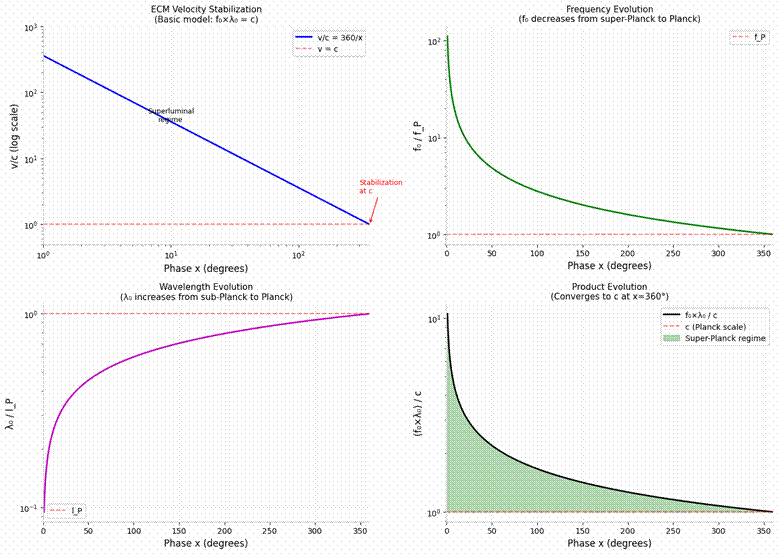
Figure 1. ECM velocity stabilization diagram showing the emergent propagation constraint under conserved phase redistribution.
Methodology
The methodological approach of Extended Classical Mechanics (ECM) is axiomatic and conservation-driven. Rather than beginning with empirical force laws, field equations, or geometric postulates, the framework is constructed from a single invariant quantity: the total phase-content of the system, denoted Φtotal.
The development proceeds through formal definition, logical partition, and structural consequence. No external ontological elements are introduced, and no auxiliary parameters are assumed beyond those required for internal consistency.
1. Foundational Postulate
The framework begins with the conservation statement:
This invariant defines the closed substrate from which all physical manifestation must arise.
2. Dual-Domain Partition
The conserved total is formally partitioned into two dynamically complementary domains:
- Frequency domain (propagative manifestation)
- Mass domain (localized manifestation)
All observable physical structure is interpreted as redistribution between these domains. No creation or annihilation of total content occurs.
3. Emergent Constraint Derivation
Propagation constraints, including light-speed invariance, are derived from conservation requirements imposed upon redistribution rates. The invariant propagation constant emerges as a structural boundary condition rather than an independent postulate.
4. Gradient Interpretation
Apparent mass is defined through redistribution potential. Spatial gradients of apparent mass generate gravitational -behaviour without introducing external curvature assumptions.
5. Temporal Construction
Time is defined as the measure of irreversible redistribution within the conserved total. Entropic partitioning establishes temporal direction as a structural asymmetry of redistribution, not as an independent dimension.
6. Logical Closure
Each axiom and derived relation is required to preserve conservation of Φtotal. No equation is introduced unless it maintains global invariance. This ensures structural closure and prevents hidden ontological expansion.
The methodology is therefore deductive, conservation-consistent, and internally self-contained. All subsequent results follow from formal redistribution dynamics within a conserved phase substrate.
PART I
Structural Foundations of Dual-Domain Conservation
1. Foundational Principle — Conservation of Phase–Mass Content
Extended Classical Mechanics (ECM) begins from a single foundational principle: existence is governed by a conserved total phase-content. This conserved content does not vanish or emerge from nothing; it redistributes between complementary domains of manifestation.
The first domain is the Frequency Domain, which describes the partition between manifested and latent frequency components. The second domain is the Mass Domain, which describes the partition between manifested mass and apparent mass arising from potential redistribution.
Frequency Partition Principle
Here, ftotal represents the conserved total phase-frequency content. The observable frequency fmanifest emerges through redistribution, while flatent represents the unmanifested reservoir.
Mass Partition Principle
Where:
- MM = total matter mass content
- Mmanifest = observable inertial mass
- Mapp ≡ −ΔPEECM
Thus, no new mass is created. Manifestation occurs through redistribution between latent and apparent components under the conservation of total phase-content.
Energy Redistribution Backbone
The manifestation principle of ECM establishes the correspondence:
Axiom I therefore formalizes the dual-domain conservation structure of ECM: frequency redistribution and mass manifestation are projections of a single, invariant phase-content.
2. The Structurally Fundamental Partition: Frequency Domain and Mass Domain
The dual-domain structure of Extended Classical Mechanics (ECM) is not introduced as an assumption. It arises as a structural necessity once conservation of total phase-content is established. The redistribution of existence must occur in two complementary projections: the frequency domain and the mass domain.
These domains are not independent ontological sectors. They are mutually linked representations of the same conserved substrate.
Frequency Partition Principle
The observable component fmanifest represents frequency that has entered measurable structure. The component flatent represents unmanifested frequency content that remains in reservoir form.
Conservation requires:
Thus, any increase in manifested frequency must correspond to a decrease in latent frequency:
Mass Partition Principle
Where:
- MM = total matter mass content
- Mmanifest = observable inertial mass
- Mapp ≡ −ΔPEECM
The apparent mass term arises directly from the redistribution of ECM potential energy. It is not an independent entity, but a manifestation of potential conversion within the conserved system.
Structural Necessity of the Dual Partition
Once total phase-content is conserved, redistribution must occur between expressed and unexpressed components. In the frequency domain this appears as manifested and latent frequency. In the mass domain it appears as manifested mass and apparent mass.
The definition
ensures that gravitational effects and mass manifestation arise from the same redistribution principle. The dual partition is therefore not a postulate but a structural consequence of conservation.
3. The Single Conserved Substrate - Physical Starting Point of ECM
Extended Classical Mechanics (ECM) begins not with spacetime, force, or quantization, but with the conservation of total phase-content. If redistribution occurs between manifest and latent states, there must exist a single conserved substrate from which both arise.
This conserved substrate is not matter, not energy in the conventional sense, and not spacetime. It is phase-content - the total structural capacity for manifestation.
Necessity of Conserved Phase-Content
From Axiom I:
Definition: Φtotal denotes the total conserved phase-content of the system.
If phase-content is conserved, then all observable phenomena must emerge from internal redistribution rather than external creation. Thus, both frequency and mass expressions are projections of the same invariant substrate.
No additional ontological categories are required.
Mapping Between Frequency Redistribution and Mass Manifestation
From Section 2:
If both partitions arise from the same conserved substrate, then frequency redistribution must correspond directly to mass manifestation.
A decrease in latent frequency implies an increase in manifested structure. That structural manifestation appears in the mass domain as:
Thus:
Frequency manifestation and mass emergence are not independent processes; they are dual representations of the same redistribution within conserved phase-content.
Emergence of the Dual-Domain Conservation Equation
Because redistribution must preserve total phase-content, the frequency and mass domains cannot evolve independently. They are constrained by a single conservation structure:
Here:
- PEECM represents latent phase-content (reservoir potential)
- KEECM represents manifested dynamical structure
The conservation equation is therefore not appended to the framework. It emerges inevitably once a conserved substrate is accepted.
At this point, ECM shifts from descriptive formulation to structural inevitability. If phase-content is conserved, dual-domain redistribution must occur, and if redistribution occurs, mass and frequency must co-emerge under a single conservation law.
4. Logical Closure of the Framework - The Foundational Dual-Domain Structure
With the conservation of phase-content established (Section 1), the structural partition defined (Section 2), and the single conserved substrate derived (Section 3), Extended Classical Mechanics (ECM) is now stated as a logically closed conservation system.
All comparative rhetoric is removed. The framework stands solely on its internal necessity.
Closed Conservation Structure
ECM asserts that total phase-content is invariant:
This invariance requires dual projection into two mutually constrained domains:
Because both domains arise from a single conserved substrate, their evolution must obey a unified conservation relation.
Formal Dual-Domain Conservation Equation
Where:
- PEECM represents latent phase-content
- KEECM represents manifested dynamical structure
The apparent mass term is defined strictly by internal redistribution:
Thus, any increase in manifested mass corresponds to a decrease in latent phase potential, preserving total invariance.
Internal Consistency Condition
No external parameters, additional fields, or auxiliary assumptions are introduced. All observable structures emerge from redistribution within the conserved system.
The framework is therefore mathematically sealed:
Frequency and mass domains are dual expressions of a single, closed conservation law.
Part I concludes with ECM defined as a complete and internally consistent dual-domain conservation structure. Further axioms introduced in Part II will extend, not modify, this foundational closure.
5. Axiom I - Dual-Domain Conservation of Phase–Mass Content
Statement of the Axiom.
Total phase–mass content is invariant. All observable structure
arises from redistribution within this conserved substrate.
Where Φtotal denotes total phase-content, the fundamental conserved quantity of Extended Classical Mechanics.
Projection into the Frequency Domain
The frequency domain expresses phase-content as measurable oscillatory structure. Manifest frequency represents observable dynamical expression, while latent frequency represents unmanifested reservoir content.
Projection into the Mass Domain
Where:
- Mmanifest is observable inertial mass
- Mapp ≡ −ΔPEECM
Mass manifestation is therefore the macroscopic projection of phase redistribution.
Energy Redistribution Backbone
Latent phase-content is represented by PEECM, while manifested dynamical structure is represented by KEECM.
All physical processes correspond to internal redistribution between these two expressions. No external creation or annihilation of phase–mass content occurs.
This axiom defines the conserved substrate of existence. All subsequent axioms extend its structural implications without altering its invariance.
6. Axiom II - Emergent Propagation Constraint and Light-Speed Invariance
Statement of the Axiom.
Propagation of manifested frequency is constrained by a stabilization
condition arising from conserved phase–mass redistribution.
Stabilization Condition
As phase-content redistributes into manifest frequency, a boundary condition emerges at structural equilibrium:
Where:
- fmanifest is manifested frequency
- λ is corresponding wavelength
- c is the invariant propagation constant
This relation is not postulated independently. It arises from the requirement that redistribution cannot exceed the rate at which phase-content can stabilize across spatial extension.
Derivation from Conservation
From Axiom I:
Manifested propagation corresponds to a balanced exchange between latent phase potential and dynamical expression. At stabilization, the product of frequency and wavelength must remain invariant to preserve total phase-content.
Thus, the propagation constant c emerges as a redistribution boundary condition.
Light-Speed Invariance as Structural Consequence
Light-speed invariance is therefore not an independent postulate. It is the limiting case of stable phase redistribution. All observers embedded within the conserved substrate measure the same propagation constant because it is defined by structural equilibrium, not by reference frame.
Axiom II establishes the invariant propagation constraint as a necessary outcome of dual-domain conservation.
7. Axiom III - Apparent Mass Gradient and the Emergence of Gravitation
Statement of the Axiom.
Spatial gradients in apparent mass generate acceleration.
Gravitation is the dynamical response to redistribution
of latent phase–mass content.
Definition of Apparent Mass
From Axiom I:
Apparent mass represents localized depletion of latent phase potential. It is not an independent substance, but a measure of internal redistribution within the conserved substrate.
Gravitational Acceleration Law
Acceleration arises from spatial variation in apparent mass:
Where:
- aECM is gravitational acceleration
- γ is the ECM coupling constant
- ∇Mapp is the spatial gradient of apparent mass
The negative sign indicates motion toward regions of decreasing latent phase potential - equivalently, toward increasing apparent mass.
Emergence of Gravitation
Gravitation is therefore not introduced as curvature of spacetime nor as an external force. It emerges as a redistribution response within the conserved phase–mass system.
Regions where latent phase-content is more strongly depleted produce measurable acceleration toward those regions.
Gravity is thus the macroscopic manifestation of spatial imbalance in latent mass distribution.
Axiom III establishes gravitation as a structural consequence of dual-domain conservation, completing the transition from invariant substrate to dynamical geometry.
8. Axiom IV - Entropic Redistribution and the Emergence of Cosmic Time
Statement of the Axiom.
Cosmic time is proportional to irreversible manifestation of mass.
Time is not fundamental; it emerges from latent phase depletion.
Irreversible Manifestation Principle
Within the conserved phase–mass system, total content remains invariant:
However, redistribution between latent and manifest domains is directionally biased at macroscopic scale. Manifest mass increases as latent potential decreases.
This directional redistribution defines irreversibility.
Definition of Cosmic Time
Cosmic time is defined as proportional to cumulative manifested mass:
Where:
- tcos is cosmic time
- η is the proportionality constant of temporal scaling
- ΔMM is net increase in manifested mass
Time therefore measures irreversible redistribution within the dual-domain conservation system.
Emergence of Temporal Direction
Because latent phase-content cannot increase without corresponding manifest depletion elsewhere, large-scale redistribution produces monotonic growth in manifested structure.
The direction of time is thus defined by increasing manifestation and decreasing latent reservoir.
Time does not pre-exist redistribution. It emerges as a macroscopic parameter tracking cumulative entropic manifestation of mass.
Axiom IV establishes cosmic time as a structural consequence of irreversible phase–mass redistribution.
9. Axiom V - Global Latent Depletion and Cosmological Termination
Statement of the Axiom.
The cosmological evolution of the universe proceeds until latent
phase–mass content is fully redistributed. Termination occurs when
apparent mass vanishes globally.
Termination Condition
Since:
the condition Mapp → 0 corresponds to complete depletion of latent phase potential gradients. No further redistribution remains available.
Consequences of Global Latent Depletion
-
Vanishing Gravitational Gradients
From Axiom III:aECM = −γ ∇MappAs Mapp → 0, its spatial gradient vanishes, and gravitational acceleration approaches zero. -
Asymptotic Freezing of Cosmic Time
From Axiom IV:Δtcos = η · ΔMMWhen manifest mass ceases to increase, cosmic time no longer advances. Temporal progression asymptotically halts. -
Maximum Cosmic Radius
Expansion driven by redistribution reaches a limiting scale:r → rmaxBeyond this radius, no additional phase–mass conversion can occur.
Cosmological Completion
The universe evolves from latent-dominated state toward complete manifestation. When latent phase-content is fully depleted, redistribution ceases, gravitational structure dissolves, and cosmic time reaches asymptotic termination.
Axiom V establishes the global boundary condition of Extended Classical Mechanics: cosmological evolution is finite, structurally determined, and governed entirely by conserved dual-domain redistribution.
Discussion
Extended Classical Mechanics (ECM) reframes physical structure as redistribution within a conserved phase substrate. Unlike conventional formulations that introduce separate dynamical sectors for gravitation, propagation, and temporal evolution, ECM derives these features as structural consequences of conservation.
1. Conservation as Structural Generator
The central distinction of ECM lies in its inversion of methodological priority. Instead of postulating force laws and then imposing conservation as a consequence, the framework begins with global invariance:
All dynamical relations must therefore preserve this invariant. Gravitation, propagation limits, and temporal direction are interpreted as redistribution effects within this constraint.
2. Gravitation Without External Curvature
Within ECM, gravitation arises from gradients of apparent mass rather than geometric curvature. This re-interpretation preserves classical intuition while avoiding the introduction of an independent spacetime ontology. The gravitational effect becomes a redistribution gradient within the conserved substrate.
3. Light-Speed Invariance as Boundary Condition
The invariant propagation constant emerges from redistribution constraints between frequency and mass domains. Light-speed invariance is therefore not an isolated postulate, but a structural boundary condition required to preserve total phase-content.
4. Temporal Direction and Entropic Asymmetry
Time is interpreted as irreversible redistribution. Entropic asymmetry reflects progressive partition within the conserved total. Under this interpretation, cosmic time is not an external parameter but a measure of cumulative redistribution.
5. Cosmological Implications
If global evolution corresponds to latent depletion within the conserved substrate, cosmological termination becomes a structural condition rather than a dynamical accident. This interpretation reframes cosmology as large-scale redistribution instead of geometric expansion alone.
6. Comparative Perspective
ECM does not negate existing classical or relativistic results. Rather, it proposes a foundational reinterpretation in which established equations appear as emergent projections of conserved phase redistribution. The framework aims at unification through invariance rather than through additional dynamical fields.
7. Limitations and Scope
The present formulation is structural and axiomatic. Quantitative correspondence with established theories requires further formal development, including explicit mapping between ECM variables and conventional dynamical quantities. The current manuscript establishes internal coherence; empirical validation remains a separate stage.
The discussion therefore positions ECM not as a replacement of classical mechanics, but as a foundational architecture from which its observed regularities may be derived.
Conclusion
Extended Classical Mechanics establishes a logically closed dual-domain conservation structure grounded in the invariance of total phase–mass content. From this single conserved substrate, frequency manifestation, mass emergence, gravitation, light-speed invariance, and cosmic time arise as structural consequences.
The framework introduces no external parameters, no independent ontological sectors, and no auxiliary assumptions. All physical phenomena emerge from redistribution within a single conserved system.
The five axioms presented define ECM as a complete foundational structure. Subsequent development extends its implications into cosmological evolution, gravitational dynamics, and entropic temporal geometry without altering its core invariance principle.
ECM therefore proposes a unified classical architecture in which mass, motion, and cosmic evolution are projections of conserved phase-content.
Declarations
Conflict of Interest: The author declares that there are no conflicts of interest regarding the publication of this paper.
Funding: This research received no external funding.
Ethical Approval: This study does not involve human participants, animals, or identifiable personal data. Therefore, ethical approval was not required.
Data Availability: No new empirical data were generated or analyzed in this study. All referenced materials are publicly available through the cited sources.
References
- Planck, M. (1899). Über irreversible Strahlungsvorgänge. Sitzungsberichte der Königlich Preußischen Akademie der Wissenschaften zu Berlin, 5, 440–480.
- Noether, E. (1918). Invariante Variationsprobleme. Nachrichten von der Gesellschaft der Wissenschaften zu Göttingen, 235–257.
- Chernin, A. D., Bisnovatyi-Kogan, G. S., Teerikorpi, P., Valtonen, M. J., Byrd, G. G., & Merafina, M. (2013). Dark energy and the structure of the Coma cluster of galaxies. Astronomy & Astrophysics, 553, A101. https://doi.org/10.1051/0004-6361/201220781
- Humpherys, D. (2024). Understanding the natural units and their hidden role in the laws of physics. European Journal of Physics, 45(5), 055802. https://doi.org/10.1088/1361-6404/ad61d3
- Thakur, S. N. (2025). A nuanced perspective on dark energy: Extended Classical Mechanics. Zenodo. https://doi.org/10.5281/zenodo.18292707
- Thakur, S. N. (2026). The ECM Master Phase Transition: Super-Luminal Origin Dynamics, Emergent Spacetime, and the Deterministic Evolution of Cosmic Expansion. Zenodo. https://doi.org/10.5281/zenodo.18644389
- Thakur, S. N. (2025). A Unified Framework Linking Entropy, Time Distortion, Gravitational Dynamics, and Cyclic Cosmology through Extended Classical Mechanics. SSRN. https://doi.org/10.2139/ssrn.5494689