
|
|
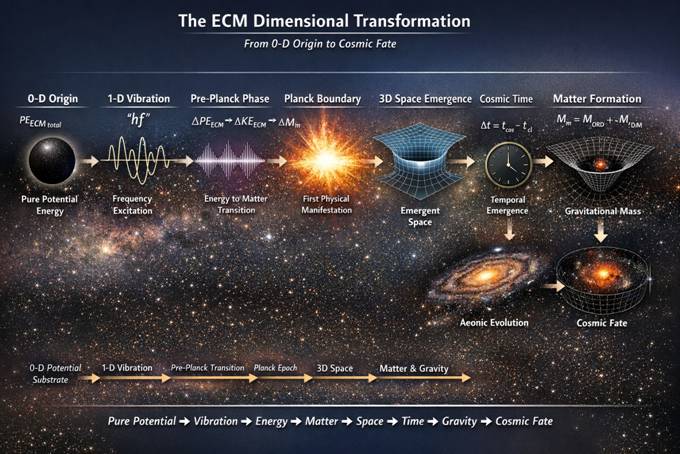
This work presents a conceptual and analytical exposition of the Dimensional Transformation Framework within the Extended Classical Mechanics (ECM) paradigm. In this formulation, the origin of the universe is not interpreted as a singular explosive event but as a transition from a 0-dimensional closed substrate of potential energy into progressively manifested physical structures governed by frequency-indexed transformations of energy and matter.
The framework describes an initial non-geometric vibrational regime in which phase evolution and frequency dynamics precede the emergence of spatial geometry and observable temporal progression. Through a sequence of phase-dependent transformations governed by the ECM manifestation principle (ΔPEECM ↔ ΔKEECM ↔ ΔMM), potential energy is redistributed into kinetic energy and incremental matter formation. The Planck epoch is therefore interpreted not as the beginning of existence but as a stabilization boundary where the primordial phase dynamics condense into the first physically manifested spacetime structure.
Within this model, the early universe undergoes a Phase-Indexed Velocity Stabilization (PIVS) process, where an initial superluminal phase velocity gradually stabilizes to the light-speed limit (c), enabling the emergence of causal structure, spatial dimensionality, and gravitational interaction. Matter mass (MM) accumulates through phase-dependent increments (ΔMM), while effective gravitational mass arises from the coupling between matter mass and negative apparent mass associated with potential-energy redistribution.
The ECM dimensional transformation therefore provides a deterministic conceptual framework connecting the primordial vibrational state, the Planck-epoch stabilization process, the emergence of spacetime geometry, and the subsequent aeonic evolution of the manifested universe. By describing cosmological origin as a frequency-governed phase transition rather than a geometric singularity, the model offers a coherent physical interpretation that avoids density paradoxes associated with zero-volume initial states while maintaining continuity with Planck-scale physics.
Extended Classical Mechanics; Dimensional Transformation; Planck Epoch; Phase-Indexed Velocity Stabilization; Frequency-Governed Cosmology; Potential Energy Redistribution; Matter Mass Emergence; Negative Apparent Mass; Primordial Vibrational State; Aeonic Universe Evolution
Archived DOI Version: https://doi.org/10.5281/zenodo.18950186
Modern cosmology seeks to explain the origin, evolution, and large-scale structure of the universe. Conventional interpretations frequently describe the cosmic beginning in terms of a singular explosive event, often referred to as the Big Bang. While this interpretation successfully describes many observable consequences of cosmic expansion, it also introduces conceptual difficulties associated with singular initial conditions, infinite densities, and undefined physical parameters at the earliest moments of cosmic history.
In particular, the description of an initial state characterized by finite mass or energy confined within vanishing spatial volume produces the well-known density paradox, typically expressed through the classical relation ρ = M / V. When the spatial volume approaches zero, the resulting density becomes mathematically undefined, indicating that the geometric framework used to describe the early universe may itself be inapplicable at the earliest stages of cosmic origin.
The Extended Classical Mechanics (ECM) framework approaches this problem from a different conceptual perspective. Instead of assuming that space, time, and matter exist at the very beginning, ECM proposes that the primordial state of the universe is a non-geometric substrate of potential energy. In this formulation the universe begins in a 0-dimensional closed state in which spatial extension, temporal progression, and conventional physical observables have not yet emerged.
Within this pre-geometric regime the earliest dynamical process is described as a frequency-governed vibrational excitation of the origin. Phase evolution and frequency dynamics precede the appearance of geometric structure. Through progressive phase transformations governed by the ECM manifestation principle (ΔPEECM ↔ ΔKEECM ↔ ΔMM), potential energy is redistributed into kinetic energy and incremental matter formation, gradually producing the physical constituents of the manifested universe.
A central element of this framework is the concept of Phase-Indexed Velocity Stabilization (PIVS). In this description the primordial vibrational state initially possesses a superluminal phase velocity that progressively stabilizes as the system evolves through a complete phase cycle. The stabilization of this velocity to the light-speed limit (c) marks the emergence of causal structure and establishes the conditions necessary for the formation of observable spacetime.
Within this perspective, the Planck epoch is not interpreted as the beginning of existence but as the first physically manifested boundary of cosmic evolution. It represents the stage at which the primordial frequency–phase dynamics stabilize sufficiently to permit the emergence of spatial dimensionality, measurable time, and effective gravitational interaction. Matter mass (MM) emerges through cumulative phase-dependent increments (ΔMM), while gravitational behavior arises from the coupling between matter mass and negative apparent mass associated with potential-energy redistribution.
The objective of the present work is therefore to present a coherent conceptual and analytical description of the Dimensional Transformation Framework in ECM. The discussion traces the progression from the primordial 0-dimensional origin through vibrational phase evolution, Planck-scale stabilization, and the subsequent emergence of the manifested universe. This perspective provides a deterministic interpretation of cosmic origin that avoids singular density conditions while maintaining continuity with Planck-scale physical parameters and observable cosmological behavior.
The present work adopts a conceptual–analytical methodology to describe the dimensional transformation of the universe within the framework of Extended Classical Mechanics (ECM). Rather than relying on purely geometric cosmological models, the approach focuses on the dynamical redistribution of potential energy and the emergence of physical structure through frequency-governed phase evolution.
The analysis begins with the postulation of a primordial state represented as a closed 0-dimensional substrate containing the total potential energy of the system. In this state spatial extension, measurable time, and observable matter are not yet defined. Consequently, conventional physical quantities such as density, spatial curvature, or relativistic metrics are not applied at this stage of description.
The first dynamical process considered in the model is the vibrational excitation of the origin. This excitation is treated as a frequency-indexed phase evolution in which the system undergoes progressive transformations governed by the ECM manifestation relation (ΔPEECM ↔ ΔKEECM ↔ ΔMM). Through this process potential energy is redistributed into kinetic energy and incremental matter formation, gradually producing the physical constituents of the manifested universe.
To describe the transition from the primordial vibrational regime to the physically observable universe, the model incorporates a phase-indexed velocity stabilization process. In this formulation the early phase dynamics are characterized by a superluminal phase velocity that progressively stabilizes as the phase angle evolves through a complete cycle. The stabilization of this velocity to the light-speed limit marks the boundary at which causal structure and spacetime geometry become physically meaningful.
The Planck epoch is therefore treated as a stabilization boundary rather than an initial singularity. It represents the stage at which the primordial frequency-phase dynamics condense into the first stable configuration of physical spacetime. Beyond this boundary, conventional physical processes such as matter accumulation, gravitational interaction, and cosmic expansion can be described using the emergent variables of mass, space, and time.
Throughout the analysis, matter mass is represented as the cumulative integration of incremental phase-dependent matter formation (ΔMM), yielding the total manifested matter mass MM. Effective gravitational behavior is interpreted as arising from the coupling between matter mass and the negative apparent mass associated with potential-energy redistribution within the ECM framework.
This methodological structure allows the cosmological narrative to be developed progressively, beginning from the primordial 0-dimensional substrate and advancing through vibrational phase dynamics, Planck-scale stabilization, and the subsequent aeonic evolution of the manifested universe.
In ECM, the universe does not originate as an explosion in pre-existing space. Instead, it emerges from a closed, non-spatial substrate of existence, a latent reservoir of potential energy:
This pre-physical substrate contains the total potential energy:
All subsequent manifestation arises from this self-contained energetic substrate.
The first departure from the uneventful state occurs when the origin undergoes a frequency excitation, representing the energetic vibration of the origin itself.
This produces the earliest form of manifestation, yet remains unmanifested to physical observation because space, time, and measurable events have not yet emerged.
Frequency and phase precede geometry and spacetime, forming the Pre-Planck vibrational regime of ECM.
Within the vibrational regime, frequency and phase structures undergo critical transitions, redistributing potential energy:
Producing the first energy-to-matter transformations through the Manifestation Principle:
Phase structures stabilize, and energy localizes into incremental matter components. Space is not yet fully formed.
When vibrational and phase excitations reach a critical threshold, the system crosses the Planck boundary, marking the Planck epoch, where:
In ECM, the Planck epoch is not the beginning of existence, but the first epoch of physically observable manifestation.
In ECM, the primordial state of the universe is treated as a non-geometric, 0-dimensional frequency–phase regime. Volume and density have no meaning, so traditional notions of "maximum density" or singularities are conceptually inconsistent.
The Planck-era transition is modeled as a phase-evolution process in which geometry, causality, and relativistic constraints emerge from a prior, purely phase-defined domain. This shifts emphasis from spatial expansion to the coherent evolution of a universal phase state, governed by frequency and phase velocity rather than metric tensors or curvature.
The Big Bang is therefore not a geometric explosion but a phase-driven stabilization process converting a 0-dimensional vibrational origin into 3-dimensional spacetime, avoiding infinities of singularity-based cosmology.
The earliest epoch, prior to the Planck boundary, is a frequency-indexed, non-geometric phase regime. "Velocity" here is explicitly a phase velocity of the state transition, not the speed of matter or energy through space, as space does not yet exist.
The phase progression is parameterized by an angle θ, ranging from 0° to 360°, indexing the primordial vibration of the origin.
Immediately before a critical phase shift, the model assigns a superluminal phase velocity:
This represents the rate of phase change in the 0-dimensional state, unconstrained by relativistic causality, which becomes meaningful only after spacetime emerges.
The PIVS stabilization curve decreases monotonically as θ progresses toward the Planck horizon. As the phase progresses, high-frequency potential redistributes into a stabilized physical state.
At a terminal phase, completing the 360° cycle, the phase velocity stabilizes at:
This locks the relativistic light-speed limit, enabling structured spacetime and light-cone causality to emerge.
The origin transitions from an uneventful symmetric phase to a dynamically evolving vibrational regime. Superluminal phase velocity decays toward c, and the excess vibrational energy converts into geometric extension—interpreted as cosmic inflation.
The superluminal phase velocity is conceptually linked to Ashoke Sen's tachyon condensation in string theory. The unstable tachyonic-like phase condenses into a stable vacuum configuration, analogous to how the ECM 0D origin stabilizes into a 3D spacetime with finite light-speed constraint.
The PIVS process is anchored in Planck units—length, time, mass, energy—to avoid referencing an undefined "void". The 0D state is treated as an energy reservoir at Planck energy EP, viewed as pure frequency oscillation rather than matter confined in volume.
The 0° → 360° phase shift corresponds to formation of a fully manifested frequency state at stabilized Planck-scale conditions. Causality and light-cone structure emerge only when the phase velocity has stabilized at c, marking the Planck Epoch as a phase transition rather than a singularity.
Phase-stabilized vibrational structures unfold into 3-D spatial geometry:
Space emerges from frequency-governed potential energy redistribution, demonstrating that geometry is secondary while energy transformation is primary.
Time arises from ongoing transformations of potential energy into kinetic and matter manifestations, measured by ECM’s entropic time deviation:
Cosmic time emerges from:
Time is a measure of transformation events, not a pre-existing background.
After dimensional transitions, the universe manifests as:
Incremental matter emergence integrates into total matter:
Decomposition into ordinary and dark matter:
Effective gravitational mass incorporates negative apparent mass:
The full ECM manifestation chain is thus:
During the ECM Planck epoch, the universe is still in a frequency–phase dominated regime, where space and gravity are not yet fully manifested. Matter (ΔMᴍ) begins to localize gradually, while the effective gravitational mass:
is still in formation, coupled to the emerging phase structures.
The negative apparent mass is linked to the ECM potential energy:
As the phase θ evolves over a full cycle:
the magnitude of −Mᵃᵖᵖ decreases, allowing incremental matter emergence ΔMᴍ:
The total matter mass Mᴍ is obtained by summing the incremental phase-dependent contributions over the complete phase cycle:
This represents the cumulative matter formation, independent of specific bodies, in ECM terms.
As ΔMᴍ accumulates and −Mᵃᵖᵖ decreases, the effective gravitational mass gradually stabilizes:
During the Planck epoch, Mɢ is still evolving, and only after the phase cycle completes does it approach its physically manifested value suitable for gravitational dynamics.
ECM Phase-Mass Relationship at Planck Epoch:
Frequency-governed potential energy redistribution produces an effective repulsive component at early stages of cosmic evolution. In ECM terms, this corresponds to the manifestation of negative apparent mass:
This repulsive effect is dynamically coupled to matter mass, driving early cosmic acceleration and seeding large-scale expansion behavior while remaining consistent with total energy conservation.
The manifested universe evolves through continuous potential-energy redistribution, driving:
The system eventually approaches the maximum gravitational radius:
This marks the terminal stage of the aeonic cycle.
This synthesis details the transition from t₀ to tᴘ, summarizing the ECM Phase-Stabilization perspective:
The Extended Classical Mechanics (ECM) dimensional transformation framework provides a coherent, deterministic model of cosmological emergence that avoids singularities and density paradoxes. By framing the universe's origin as a 0-dimensional closed substrate, the framework emphasizes frequency-governed phase dynamics rather than pre-existing spatial coordinates or metric-based singularities.
The initial vibrational regime, governed by phase evolution, establishes the preconditions for matter formation. Incremental phase-dependent transformations of potential energy (ΔPEECM) into kinetic energy (ΔKEECM) and matter mass (ΔMM) demonstrate how observable physical structures emerge from a non-geometric state. This phase-indexed accumulation ultimately yields the total matter mass (MM) and the effective gravitational mass (Mɢ = MM + (−Mᵃᵖᵖ)), preserving the deterministic link between energy redistribution and gravitational behavior.
Phase-Indexed Velocity Stabilization (PIVS) explains the transition from superluminal phase velocities to the light-speed limit (v = c). This mechanism accounts for the emergence of causality, 3-dimensional space, and temporally measured events, providing a natural explanation for the onset of physically meaningful spacetime. It further clarifies how the Planck epoch functions as a boundary for stabilization, rather than a singular origin.
The inclusion of negative apparent mass (−Mᵃᵖᵖ) in the effective gravitational mass calculation provides a quantitative description for repulsive effects that manifest in early cosmic expansion. This also supports contemporary observational phenomena such as large-scale cosmic acceleration, cluster dynamics, and dark-energy-like behavior within a deterministic ECM framework.
By maintaining a sequential narrative from the 0-dimensional substrate, through phase-vibrational emergence, Planck-phase stabilization, and aeonic evolution, the framework consistently links microscopic phase dynamics to macroscopic cosmic structure. This deterministic chain avoids arbitrary initial conditions while preserving compatibility with Planck-scale constraints.
Overall, the ECM discussion emphasizes that cosmological origin, matter formation, and gravitational interaction can be coherently described through frequency- and phase-governed transformations, providing a physically meaningful alternative to singularity-based models.
The Extended Classical Mechanics (ECM) Dimensional Transformation framework provides a deterministic, phase- and frequency-governed model of cosmological emergence. By conceptualizing the universe as originating from a 0-dimensional closed substrate, the model avoids singularities and density paradoxes while providing a physically meaningful narrative from the primordial vibrational regime to the emergence of spacetime and matter.
Incremental phase-dependent transformations of potential energy (ΔPEECM) into kinetic energy (ΔKEECM) and matter mass (ΔMM) form the deterministic chain leading to total matter mass (MM) and effective gravitational mass (Mɢ = MM + (−Mᵃᵖᵖ)). This approach links microscopic phase dynamics directly to macroscopic cosmic structure, including spatial geometry, temporal progression, and gravitational interactions.
The Phase-Indexed Velocity Stabilization (PIVS) mechanism clarifies the transition from superluminal phase velocities to the light-speed limit (v = c), enabling the emergence of causal structure and physically meaningful spacetime. The Planck epoch is interpreted as a boundary of phase stabilization rather than a singular beginning, preserving compatibility with Planck-scale physics.
The framework also naturally accommodates phenomena such as primordial repulsive states, dark-energy-like behavior, and cosmic acceleration through the inclusion of negative apparent mass (−Mᵃᵖᵖ) within the effective gravitational mass. By maintaining sequential phase-governed evolution from the 0-dimensional substrate to aeonic cosmic fate, ECM provides a unified, deterministic explanation for the origin, structure, and evolution of the universe.
In conclusion, the ECM Dimensional Transformation framework offers a coherent physical alternative to singularity-based cosmologies, emphasizing frequency, phase, and energy redistribution as the primary drivers of cosmic manifestation, while providing explicit quantitative links to matter formation and gravitational behavior.