
|
|
Extended Classical Mechanics (ECM) reformulates physical emergence by establishing frequency as the primary ontological quantity from which energy, mass, gravitation, entropy, and time arise. This work demonstrates that the fundamental relation E = hf precedes and governs all energetic manifestation, while the relativistic mass–energy equivalence E = mc² appears only as a derivative consequence of frequency transformation. By introducing an intrinsic pre-Planck frequency exceeding the Planck threshold by a single oscillatory cycle, a minimal energetic imbalance is shown to generate potential energy reservoirs, Negative Apparent Mass (NAM), and subsequent mass manifestation through ECM’s entropic transformation principle. The derivation of the ECM proportionality constant reveals that Planck’s constant represents a limiting case of deeper frequency scaling. Furthermore, time itself is demonstrated to emerge from cumulative phase surplus between intrinsic frequency evolution and stabilized Planck-scale manifestation, establishing temporal flow as an entropic consequence rather than a fundamental dimension. Together, these results present a unified frequency-governed origin of physical reality, replacing explosion-based cosmological interpretations with controlled energetic transformation dynamics.
Extended Classical Mechanics; frequency-governed energy; Planck-scale emergence; intrinsic frequency excess; ECM proportionality constant; Negative Apparent Mass (NAM); ΔPEₙₐₘ; entropic transformation; emergent time; phase surplus dynamics; energy partitioning; non-relativistic mass emergence; cosmological frequency transformation
A formal preprint version of this work is available via
Social Science Research Network (SSRN):
https://doi.org/10.2139/ssrn.6221099
The relation between energy and frequency introduced by Max Planck,
established that energetic manifestation is intrinsically tied to oscillatory processes and laid the foundation of quantum theory. In contrast, the relativistic formulation
reinterpreted energy as a property of inertial mass. While both relations are experimentally verified, their physical hierarchy has remained conceptually unresolved — whether energy originates from mass or whether mass itself emerges from deeper energetic dynamics.
Conventional physics implicitly assumes time and spacetime geometry as fundamental backgrounds within which frequency, energy, and mass evolve. Cosmological models further extend this assumption through singular explosive origins to account for the appearance of matter and energy. However, such frameworks do not explain why energy should be quantized by frequency, nor how mass, gravitation, entropy, and temporal flow originate from a unified physical mechanism.
Extended Classical Mechanics (ECM) resolves this hierarchy by identifying frequency progression as the primitive physical process from which all energetic and material phenomena emerge. Within ECM, Planck’s relation is elevated from a quantum postulate to the foundational energetic law governing manifestation. Mass is not treated as a primary substance but as a stabilized energetic configuration arising from entropic frequency imbalance, formalized through:
A central result of ECM is that intrinsic pre-Planck frequency exceeds the Planck threshold by a minimal single-cycle phase surplus. This infinitesimal excess generates the primordial energetic deficit responsible for potential energy reservoirs, Negative Apparent Mass (NAM), and subsequent mass manifestation — replacing explosive cosmological assumptions with controlled frequency-to-energy transformation.
ECM further demonstrates that time itself is not fundamental but emerges from cumulative phase imbalance between intrinsic frequency evolution and stabilized energetic manifestation. Temporal flow therefore reflects entropic frequency drift rather than an independent dimension.
This work establishes the ECM-consistent emergence of energy, mass, gravitation, and time by deriving the pre-Planck proportionality constant, linking it directly to energetic imbalance and NAM formation, and demonstrating how single-cycle frequency excess generates observable temporal progression.
Extended Classical Mechanics identifies a minimal intrinsic frequency excess as the fundamental physical trigger for all energetic and material emergence. Prior to manifestation, existence remains in a perfectly balanced intrinsic oscillatory state characterized by f₀. When this intrinsic frequency exceeds the Planck threshold by a single completed phase cycle, a microscopic energetic asymmetry is introduced.
This imbalance is not a fluctuation but a structural consequence of frequency progression:
where Δf₀ corresponds to one completed intrinsic phase cycle. For minimal emergence, Δf₀ → 1 cycle equivalent.
Through Planck’s fundamental relation, this surplus converts directly into an energetic shortfall:
Rather than producing explosive release, ECM predicts the formation of a stabilized potential-energy reservoir. This reservoir appears dynamically as Negative Apparent Mass (NAM):
NAM acts as the energetic driver of all subsequent physical dynamics. Its continuous manifestation redistributes energy into:
Thus:
No independent mass substance is required. Matter is a persistent energetic configuration sustained by entropic frequency transformation.
As the intrinsic frequency continues to progress beyond perfect phase closure, the imbalance accumulates continuously. This accumulation governs not only energy and mass formation but also the progressive unfolding of time itself.
Hence, ECM establishes a single unified physical mechanism:
The Planck scale therefore marks a stabilization boundary — not an explosive origin — where intrinsic oscillatory existence transitions into dynamically evolving physical reality through controlled entropic imbalance.
Extended Classical Mechanics begins not from mass-based energetics but from intrinsic oscillatory existence. The foundational physical quantity is frequency, with energy emerging directly as:
No independent rest-mass entity is assumed. All energetic and mass-like manifestations arise as secondary consequences of frequency redistribution.
At the fundamental threshold:
where Δf₀ corresponds to one completed intrinsic phase cycle. For minimal emergence, Δf₀ → 1 cycle equivalent.
The Planck reference state follows directly from frequency quantization:
This defines the energetic stabilization boundary of manifested reality. Mass scales traditionally associated with Planck quantities are therefore derivative bookkeeping measures - not primary physical origins.
The infinitesimal frequency surplus produces a corresponding energetic imbalance:
This deficit is the primordial ECM potential-energy reservoir from which all dynamics unfold.
ECM defines the associated apparent mass manifestation as:
This Negative Apparent Mass (NAM) is not exotic matter - it is the energetic shortfall required by frequency imbalance.
The fundamental energetic conversion pathway follows:
In atomic transitions, electrons drop between quantized states, and the energetic loss manifests as photon emission governed by:
Thus, quantum emission is not an isolated phenomenon but a direct redistribution of ECM energetic deficit.
Within ECM, when mass is expressed in frequency-governed form, the velocity mapping follows:
leading to the kinetic emergence relation:
This ECM formulation demonstrates that:
In ECM, motion does not originate from an applied force acting on an intrinsic mass. It arises because intrinsic frequency imbalance continuously converts potential deficit into manifested matter variation and dynamic propagation.
The frequency surplus (f₀ - fₚ) generates an energetic shortfall:
This deficit manifests as matter redistribution ΔMₑ, which necessarily appears as dynamical evolution:
Thus kinetic energy in ECM is not an independent mechanical quantity—it is the dynamical face of frequency-driven energetic rebalancing. Motion is therefore the physical expression of ongoing frequency correction toward intrinsic equilibrium.
When frequency-driven mass manifestation is small compared to total effective mass, ECM dynamics reduce smoothly to classical mechanics.
For massive particles, ECM defines:
with the energetic conversion:
For low velocities where frequency redistribution is weak, the manifested mass change satisfies:
Substituting into the ECM kinetic expression:
which is precisely the classical Newtonian kinetic energy formula. Therefore, classical mechanics emerges naturally as the low-frequency-disturbance limit of ECM—not as a separate foundational theory. ECM does not modify classical results; it explains their physical origin.
At any scale, the total manifested energetic content satisfies:
or equivalently:
showing that observable dynamics always operate atop an underlying ECM potential deficit.
The same frequency excess that produces energetic imbalance also generates temporal progression:
Thus time, energy, mass, and gravitation share a single causal origin: intrinsic frequency imbalance relative to the Planck stabilization boundary.
Classical relativity postulates:
ECM instead demonstrates that:
Mass is therefore not a fundamental energy source but a manifested outcome of frequency-driven energetic redistribution. Energy is governed by frequency—not by intrinsic mass equivalence.
The following sections develop the physical mechanism underlying this formal structure, beginning from intrinsic frequency behaviour at the pre-Planck threshold.
In Extended Classical Mechanics, the energy–frequency relation
is more fundamental than E = mc²; the concept of rest mass m₀ is not physically meaningful, even at the Planck scale. Energy emerges first through frequency transformations:
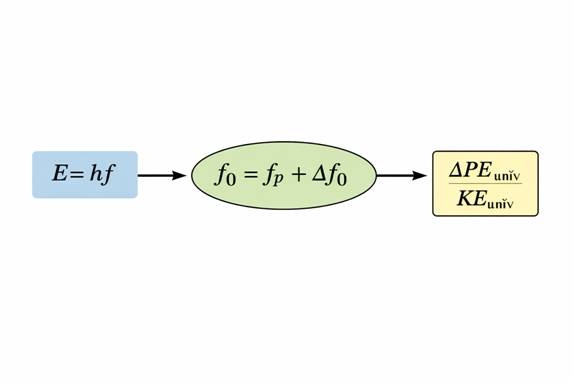
From this, the universal energy partition follows naturally:
Thus, potential and kinetic energies, along with mass manifestations, are derivative consequences of fundamental frequency dynamics, making E = hf the primary descriptor of physical reality.
Before the emergence of Planck-scale energy-mass manifestations, the intrinsic frequency f₀ defines fractional time intervals for a cycle of x°:
Intrinsic frequency is slightly higher than Planck frequency:
After energy-mass manifestation, the source frequency fₛ determines observed intervals, while the measured frequency fₘ is lower:
Source frequency exceeds observed frequency:
These relations establish the primary ECM logic: frequency emerges first (E = hf), and mass-energy is derivative. No relativistic assertion is required to justify energy-frequency equivalence at Planck scale.
Within ECM, the emergent temporal increment at any fractional phase shift can be expressed as:
where φ represents the cumulative phase shift in degrees. This linear mapping illustrates the proportionality between microscopic phase surplus and measurable emergent time.
Consequently, infinitesimal phase deviations generate corresponding frequency and energy deviations:
These expressions encode the direct energetic consequence of phase evolution, providing the microscopic link between frequency, potential energy, and emergent time.
Thus, ECM establishes a fundamental hierarchy of emergence:
This framework demonstrates that ECM time is a derived, cumulative effect arising from infinitesimal frequency and phase imbalances, reinforcing the conceptual departure from a pre-existing temporal dimension.
Future modeling of cosmological emergence in ECM can leverage this phase-time correspondence to simulate early-universe entropic accumulation, mass generation, and the onset of gravitational dynamics.
The present formulation establishes a reversal of the conventional energetic hierarchy by demonstrating that frequency - not mass - constitutes the primary physical driver of all energetic manifestation. Within the ECM framework, Planck’s relation E = hf is elevated from a quantization rule to the foundational dynamical law of reality, while relativistic mass–energy equivalence emerges only as a secondary bookkeeping identity describing stabilized energetic configurations.
The introduction of an intrinsic pre-Planck frequency exceeding the Planck threshold by a single completed oscillatory cycle provides a physically minimal and non-singular origin for energy, mass, and gravitation. Rather than invoking explosive creation events or undefined singular states, ECM demonstrates that an infinitesimal entropic phase surplus necessarily produces an energetic deficit:
This deficit manifests dynamically as Negative Apparent Mass (NAM), which acts as the universal energetic reservoir driving matter formation, motion, and gravitational behaviour. All observed physical structures therefore arise from continuous redistribution of this primordial imbalance through:
The derivation of the ECM proportionality constant further reveals that Planck’s constant itself represents a limiting manifestation of deeper frequency scaling. The infinitesimal deviation of k from h encodes the exact entropic trigger required for physical emergence, grounding Planck-scale physics within a continuous transformational mechanism rather than discrete postulates.
A particularly significant outcome is the emergence of time as a direct consequence of frequency imbalance. The progressive phase surplus between intrinsic oscillatory completion and stabilized Planck-scale manifestation accumulates into measurable temporal flow, demonstrating that time is not a pre-existing dimension but an entropic consequence of energetic transformation.
This unification implies that:
All fundamental physical phenomena therefore share a single causal origin in intrinsic frequency dynamics.
Cosmologically, ECM replaces explosion-based Big Bang interpretations with a controlled frequency–energy transformation process governed by minimal entropic disturbance. The Planck scale functions as a stabilization boundary rather than a creation singularity, marking the transition from intrinsic oscillatory existence to dynamically evolving physical reality.
In this light, ECM offers a unified non-relativistic, non-singular, frequency-governed foundation for energy, matter, gravitation, entropy, and time - resolving longstanding conceptual discontinuities between quantum theory, classical mechanics, thermodynamics, and cosmology.
| Symbol / Term | Description (ECM Interpretation) |
|---|---|
| Δf₀ | Intrinsic frequency surplus beyond Planck reference frequency responsible for energetic imbalance. |
| Δfꜱᴏᴜʀᴄᴇ | Difference between source frequency and observed frequency after energy manifestation. |
| ΔMᴍ | Manifested matter mass emerging from ECM energetic redistribution. |
| ΔPEᴇᴄᴍ | ECM potential energy deficit generated by intrinsic frequency excess; primordial energetic reservoir. |
| Δt , Δtₛ | Emergent time increment arising from cumulative phase surplus between intrinsic and Planck-scale cycles. |
| E | Energy directly emerging from frequency via the fundamental ECM relation E = hf. |
| Eᴘ | Planck-scale stabilization energy defining the manifestation boundary of physical reality. |
| Eₜₒₜₐₗ | Total manifested energy partitioned into ECM potential and kinetic components. |
| f | General frequency governing energy emergence. |
| f₀ | Intrinsic pre-Planck frequency of oscillatory existence prior to energetic manifestation. |
| fᴘ | Planck reference frequency defining stabilization threshold of manifested reality. |
| fꜱᴏᴜʀᴄᴇ | Frequency of the energetic source after mass-energy manifestation. |
| fᴏʙꜱᴇʀᴠᴇᴅ | Measured frequency reduced due to energetic redistribution. |
| h | Planck constant representing frequency-to-energy conversion coefficient. |
| k | ECM pre-Planck proportionality constant encoding intrinsic entropic frequency excess. |
| KEᴇᴄᴍ | Kinetic energy component arising from dynamic redistribution of ECM energetic deficit. |
| Mᵃᵖᵖ (NAM) | Negative Apparent Mass - manifestation of ECM potential energy deficit driving dynamics. |
| Mᴘ | Planck bookkeeping mass derived from Planck energy scale (not fundamental in ECM). |
| PEᴇᴄᴍ | Total ECM potential energy including intrinsic deficit component. |
| PEᵉᶠᶠ | Effective observable potential energy after subtracting ECM deficit. |
| Tₓ° | Fractional intrinsic cycle time corresponding to phase angle x°. |
| x° | Phase progression angle within intrinsic oscillatory cycle. |
This index summarizes the fundamental ECM quantities governing frequency-driven energy emergence, energetic imbalance, mass manifestation, and the entropic origin of time.
Planck, M. (1901). On the Law of Distribution of Energy in the Normal Spectrum. Annalen der Physik, 4(553), 1–11. (Origin of the fundamental energy–frequency relation E = hf establishing Planck-scale quantization) Original archive | English translation (PDF)
ECM Foundational Origin, Measurement Scales, and Energetic Emergence: https://www.researchgate.net/publication/400577749
ECM: The Uneventful Source of Existence and the Closure of the Cosmic Circuit: https://doi.org/10.13140/RG.2.2.18795.60965
ECM Integrated Phase Kernel Formalism: https://doi.org/10.13140/RG.2.2.17068.73608
ECM Unified Frequency-Gravity-Mass Redistribution: https://doi.org/10.13140/RG.2.2.16090.61120
ECM Perspectives on Cosmological Models: https://doi.org/10.13140/RG.2.2.18043.58403
ECM: From Uneventful Energy to Manifested Universes: https://doi.org/10.13140/RG.2.2.30930.00966
ECM: Universe – From Origin to Fate: https://doi.org/10.13140/RG.2.2.12329.25444
ECM: Research Foundations for Cosmic Dissolution: https://doi.org/10.13140/RG.2.2.19354.71367
ECM: Bridge between Sen’s Conjecture and Penrose’s Conformal Cyclic Cosmology: https://doi.org/10.13140/RG.2.2.23039.47521